

 (Photo: VNA)
especially pregnant women and young children.
The information was announced at a recent symposium to welcome
Micronutrient Day (June 1-2).
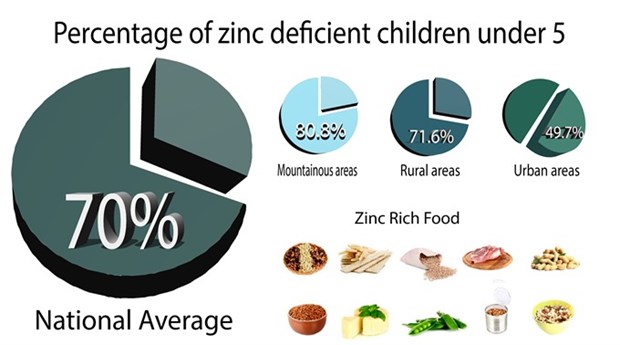
A survey conducted in 2015 showed that nearly 70 percent of
children under five suffer from zinc deficiency. Children from mountainous
areas are most affected, at 80.8 percent. The figures are 71.6 percent for
children in rural areas and 49.7 percent for children in urban areas.
is also common among women. About 64 percent of
women of reproductive age are zinc deficient while the rate is 80 percent for
pregnant women.
Zinc is an essential mineral which affects many organ systems,
including the immune, skeletal, reproductive, and central nervous systems.
“Zinc is involved in the activity of more than 200 enzymes in the
body, which affects the height and intellectual development of a child. Zinc
deficiency during pregnancy increases the risk of complications,” said Dr Tran
Khanh Van, deputy head of Micronutrient Department of the National Institute of
Nutrition (NIN).
Associate Professor Nguyen Thi Lam, NIN vice director, added that
zinc deficiency may also result in malnutrition, being underweight, loss of
appetite, sleep disorder, and disturbed sleep.
The body does not produce zinc so people have to absorb zinc from
food.
According to a NIN report, ’s daily meals
generally provide enough energy and protein but not enough vitamins and
minerals.
This is the main reason for zinc deficiency.
An average infant should consume 2-3 milligrams of zinc daily,
while a 4-8kg child should consume 5mg. Adult men should aim to consume
about 11 milligrams of zinc daily, while adult women need about 8 milligrams.
Pregnant women and nursing women require 11 to 12 milligrams and 12 to 13
milligrams per day, respectively.
According to experts, zinc deficiency can be treated by increasing
intake of zinc through the diet or through zinc supplements.
The mineral is present in many foods and is especially rich in
seafood like oysters, shrimp, or crab; meat like pork, chicken, or egg yolks,
peanuts and pumpkin seeds.
Zinc is, however, not the only mineral that Vietnamese people’s
meals lack.
According to NIN, the diets of Vietnamese people have led to the
deficiency of various important vitamins and minerals, such as vitamin A,
iodine, iron, calcium, and vitamin D.
Vitamins and minerals are needed in tiny quantities, but their
absence can be devastating.
“Micronutrient deficiency is considered a “hidden-hunger” with
far-reaching consequences, such as physical and intellectual growth
retardation, or a decrease in reproductive and working capability,” Dr Van
said.
Dr Van said people of all ages are prone to micronutrient
deficiency, but those at high risk are young children and .
About 13 percent of children under five suffer from preclinical
vitamin A deficiency. According to experts, their meals only provide about 65 percent
of the amount needed.
Meanwhile, 34.8 percent of nursing women have low rate of vitamin
A in their milk for the same reason.
Anemia appears in 27.8 percent of children under five and 32.8 percent
of pregnant women.
Doctors recommend that people increase their intake of
micronutrients by having a diverse diet and eating micronutrient-rich food.
“This is a simple, yet effective and substantial method to solve
the micronutrient deficiency situation and increase people’s health and living
quality,” said Associate Professor Truong Tuyet Mai, NIN vice director, adding
that communication and education should be used to raise the awareness of people
on micronutrient-rich foods.-VNA
Source: VietnamPlus


