

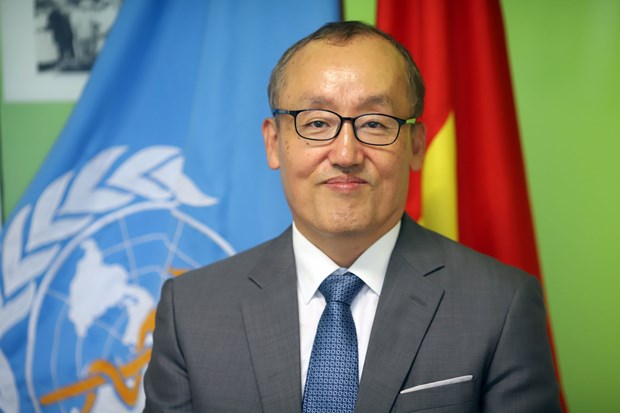
 , WHO Representative in Vietnam (Source: WHO)
Hanoi (VNA) – Dr Kidong Park, ,
has granted an exclusive interview to the Vietnam News Agency on the Vietnamese
government’s response to the COVID-19 pandemic and WHO’s support for Vietnam in
the effort.
The following is the full text of the interview:
Question: How do you see the fourth COVID-19 wave in Vietnam now?
Answer: We are very closely monitoring
the situation of the ongoing outbreak in Vietnam. It has been evolving fast and
is complex in nature. It has quickly spread to a number of cities and
provinces, including in industrial zones. Two types of variants of concern (B.1.1.7 and
B.1.617.2) have been detected. These factors
make case investigation and contract tracing very challenging.
The next few weeks can be crucial in controlling this outbreak. With
the aggressive contact tracing and testing, it can be expected that more cases
will be identified, and more provinces/cities could be reporting cases. There
is a very high risk of additional cases to continue to be reported in the
coming days from the community, and possibly from people who are isolated as F1.
Q: What is WHO’s evaluation on Vietnamese government’s
measures to cope with the pandemic?
A: Vietnam has intensified
its response measures that have been proven to work in the past outbreaks. These
have been adjusted on a daily basis as
the situation evolves.
We do hope and have confidence that Vietnam could suppress
current outbreaks with a whole-of-government and a whole-of-society approach.
Q: How do you evaluate the COVID-19 vaccination in
Vietnam?
A: Similar to
other developing countries, Vietnam is facing many challenges, including limited vaccine
supply, uncertainty of the shipment schedule, short vaccine shelf life, etc. As of 14 May, about 950,000 people have been
vaccinated in Vietnam since the first vaccination on 8 March 2021.
Good news is that Vietnam received
additional 1,682,400 doses of AstraZeneca COVID-19 vaccine from the COVAX
Facility on 16 May 2021. These additional vaccines
will further expand the vaccination of priority groups in the coming months.
Q: How is WHO supporting Vietnam in accessing vaccine
sources and low-price accurate and fast coronavirus testing methods in the
coming time?
A: Vaccines
is a co-creator
of the COVAX Facility. The COVAX Facility is committed to provide
vaccines covering up to 20% of the population to its participating countries, including
Vietnam, by the end of 2021.
In addition, WHO and partners are seeking
to expand the capacity of low- and middle-income countries (LMICs) to
produce COVID-19 vaccines and scale up manufacturing to increase global access
to these critical tools to bring the pandemic under control.
To implement this idea, WHO is
seeking expressions of interest from manufacturers of medical products
preferably in LMICs, which could host a COVID-19 mRNA hub which will assemble
the technology up to good manufacturing practices-grade pilot lots for clinical
trials; and transfer the appropriate know-how and technology to existing or new
manufacturers in LMICs to enable them to develop and produce COVID-19 mRNA
vaccines.
In the coming weeks, WHO will
issue another call for interest from manufacturers in LMICs interested in
receiving the technology developed by the technology transfer hub(s).
A vaccine manufacturer in
Vietnam has already expressed its interest to become a mRNA-based COVID-19
vaccine technology transfer hub. It is being reviewed by WHO Head Quarters. It
is expected that Vietnam will also apply for large scale manufacturing of
mRNA-based COVID-19 vaccine.
If Vietnam will host a mRNA-based COVID-19
vaccine technology transfer hub, it will contribute to mRNA-based COVID-19
vaccine production in Vietnam as well as in the Region.
Testing methods
WHO is continuing to support the development of
faster, more accurate, affordable and easier-to-use laboratory tests as well as
supporting access to affordable, quality COVID-19 tests in all countries,
in particular low and middle-income countries.
For Vietnam, WHO has been providing technical advice
to develop national testing strategies and guidelines. We have also provided
laboratory testing materials including specimen collection kits and reagents
for RT-PCR. We are committed to continue to do so.
Q: In your opinion, should people in quarantine take
their own samples for testing to reduce risks and share the burden for medical
staff?
A: Collection of a good quality specimen is a critical first
step in ensuring quality laboratory testing. A sub-optimal or poorly collected
specimen can compromise the quality of a laboratory result and could
potentially even lead to false negative results.
Therefore, WHO strongly advises that specimen collection should
be carefully conducted by trained personnel, following rigorous adherence to
infection prevention and control guidelines. This also includes appropriate
personal protective equipment, following MOH guidance.
We also reiterate that laboratory testing should balance public
health impact with the available material and human resources. If laboratory
testing is becoming a large burden for medical staff and material shortfall is
expected, it may be time to re-examine the current testing practice and to
prioritize resources to higher impact targets./.
Source: VietnamPlus


