
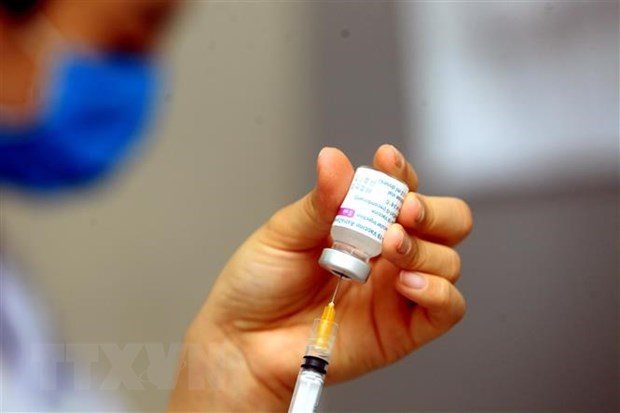
 Illustrative image (Photo: VNA)
 Covax, will begin Phase 3 of clinical trials in June involving up to 13,000
volunteers.
This
follows promising results seen in the first two phases.
The
under the Ministry of Health
said it has agreed in principle for the final phase in of the
sub-unit vaccine based on recombinant DNA/protein
technology developed by Ho Chi Minh City-based biopharmaceutical company
Nanogen.
Researchers
need to submit some more documents this week for the ministry to review and
officially greenlight the trials.
Phase
3 will be divided into smaller segments – with the first involving some
800-1,000 registered volunteers and will gradually expand to larger groups in
future segments. The Vietnam Military Academy in Hanoi and Hung Yen province’s
health authorities in the north, along with and HCM City Pasteur Institute and
Long An province’s health authorities will help administer the vaccines in
volunteers and monitor responses.
The
optimal dosage for the phase 3 will be 25mcg. All three dosages of 25mcg,
50mcg, and 75mcg of the vaccine trialled in the first two phases provided
largely similar level of immune responses against coronavirus (SARS-CoV-2) so
the committee chose the lowest dosage to save on materials.
Phase
2 of human trials, involved 554 people including 108 elderly, was
completed on April 8 this year but monitoring of the volunteers’ health for
effectiveness and potential side effects could last up to a year. So far
the results have been quite promising, the committee said.
The
immune response increased by 60 times 35 days after the first shot in some
volunteers, and the protection level remains at 34 times the normal level after
three months.
All
volunteers injected with the jabs produced immune response against the virus.
The
vaccine has the capacity to generate neutralising antibodies against the
original version of first found in China’s Wuhan as well as mutant
variants first identified in South Africa during phase 2 trials, but more
studies in phase 3 are needed to clarify how effective it could be against the
Indian variant that is wreaking havoc across the northern region of Vietnam in
the fourth wave of infections.
After
injection, volunteers exhibited symptoms such as pain at the injection
point, light fever, muscle aches, joint pain, and fatigue, which are
typical post-injection reactions. However they did not require medical
intervention.
If
things go well, phase 3 trials could conclude by the end of September and
commercial production could start soon after.
There
have been talks earlier this week about using Nano Covax on a wider scale
in case of severe outbreaks, similar to how Russia’s Spunit V, the world’s
earliest COVID-19 vaccine to be approved and still one of the most
effective, is administered on general population when data from phase 3
have not been fully available.
Lao
dong (Labour)
newspaper, citing a ‘reliable source,’ said that Nano Covax has received
millions of dollars in financial donations from a domestic conglomerate for the
third phase of trials and eventual inoculation of the country of near 100
million-strong population to achieve vaccination goals within this year,
helping to open up the economy and re-enable travel and tourism.
The
support also extended to ramping up of production capacity in order to meet the
domestic demands as well as possible exports of Nano Covax vaccines.
Nguyen
Ngo Quang, Deputy Director of the Department of Science, Technology and
Training under the health ministry, said if Vietnam could have its own
manufacturing technology domestically then it would be easier to evaluate and
adjust the vaccines in cases of new variants.
Deputy
Prime Minister Vu Duc Dam, 58, head of the National Steering Committee for
COVID-19 Prevention and Control, along with Deputy Minister of Science and Technology
Pham Cong Tac, 59, received two full doses of Nano Covax as part of the trials.
The
price for each dose was projected to be 120,000 VND (5.2 USD). The doses are
given intramuscularly with the spacing between each dose about a month (28
days), according to Nanogen.
Another
domestic vaccine contender, Covivac by Institute of Vaccines and Biological
Medical (IVAC) in Nha Trang city is preparing phase 1 trial’s data to be
reviewed by the health ministry and could start phase 2 around late June-early
July if the results are deemed acceptable.
Another
locally developed COVID-19 vaccine by Vabiotech is in preclinical trials
on animals, and another from Polyvac (Centre for Research and Production
of Vaccines and Biologicals, under the health ministry) is still researching in
labs.
Polyvac
said it is in talks with Russia’s relevant parties for technology transfer of
Sputnik V (already approved for emergency use in Vietnam) for commercial
production domestically later this year./.
Source: VietnamPlus


