
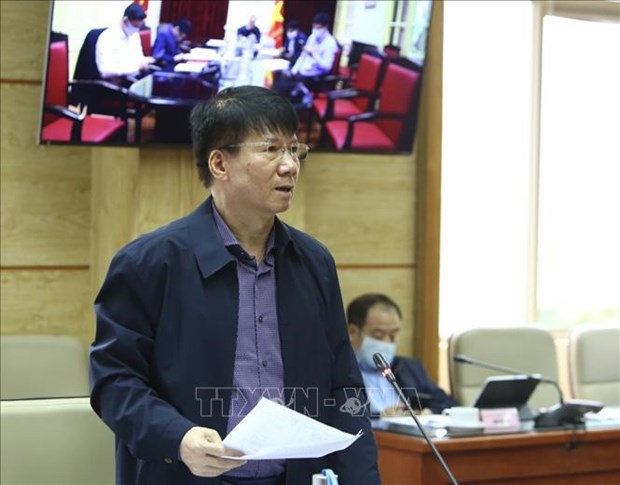
 Deputy Minister of Health Truong Quoc Cuong (Photo: VNA)
Hanoi (VNA) – Vietnam shared its experience in COVID-19 prevention and
control at the G20 health ministers’ meeting via video conference on late April 19.
The
session was attended by Director-General of the (WHO)
Tedros Adhanom Ghebreyesus and health ministers from the G20 countries, along
with officials from international and regional organisations like the World
Bank, the Organisation for Economic Cooperation and Development (OECD), the
United Nations Foundation, and the Global Alliance for Vaccines and Immunisation (GAVI).
At the meeting,
which followed the leaders’ video summit in March that discussed global
responses to , the officials shared their countries’ experiences
and proposed urgent measures to fight the pandemic.
In his remarks, Deputy Minister of Health Truong Quoc
Cuong said Vietnam, which is ASEAN Chair in 2020, had successfully organised
the Special ASEAN and ASEAN+3 Summits on COVID-19.
At those events, participating leaders reaffirmed
their determination and commitments to remaining united, and to act jointly and
decisively to control the spread of the COVID-19 pandemic to mitigate its
adverse impacts on people’s livelihoods, societies and economies in the region,
he noted, adding it is of crucial importance that the ASEAN+3 (China, Japan,
Republic of Korea), ASEAN-US, and ASEAN-EU mechanisms and other international
communities highlighted the urgency of the pandemic and committed to a
collective response.
Talking about
Vietnam and ASEAN’s expertise, Cuong noted the country had set up a national
steering committee for COVID-19 prevention and control during the early stages
of the outbreak with strong commitment from the whole political system, the
Government and the public.
He said the Vietnamese Government has appealed for national unity against with the motto of “fighting the pandemic like fighting the enemy”.
Besides, Vietnam has been applying a strategy of “prevention – early detection
– quarantine and treatment”, and engaging local authorities to direct and
mobilise all resources on site. It
has implemented early measures to prevent transmission from abroad while
identifying and controlling effectively transmissions within the country.
Measures have been taken to control and limit the spread of the
disease, such as early quarantine for suspected cases, mass testing for everyone
coming from affected areas and epicentres, and social distancing. Vietnam has
actively collaborated with partners in different spheres to improve testing,
research, investigation and treatment protocols for the most effective outcomes
despite limited resources, the official said.
He added a health app was introduced for citizens to update their daily
health statuses and provide information about suspected cases in their areas.
The app is also helping the nation’s health sector to identify individuals in
need of medical assistance in the fastest and most effective manner, serving as
an official channel to disseminate information bout the pandemic as well as health
recommendations for the public.
Cuong went on to say that from economic and social perspectives, the Vietnamese Government has issued incentives to mitigate the impacts of COVID-19,
including tax breaks and permissions for late payment of taxes,while simultaneously offering policies to
support businesses, investors, small traders, and the public.
The country has adopted a dual approach of containing and controlling the
outbreak while sustaining socio-economic stability. Immediate actions have been
taken to help people facing hardships, particularly the vulnerable, poor and workers, making sure
that no one is left behind, he said.
The deputy
minister said as the current Chair of ASEAN and a non-permanent member of the UN
Security Council, Vietnam has also made efforts to raise a coherent response to
the pandemic, including timely sharing of information on COVID -19 detection
and treatment, standardised measures for health inspections at borders and
entry points, and consular assistance to ASEAN nationals.
Additionally,
a cross-sectoral ASEAN working group involving senior officials of health,
foreign affairs, defense, immigration, and transport has been established to
develop a regional holistic response to the pandemic and its widespread
disruption. Practical measures in the agreement aim to ensure information
exchange and policy coordination among the member states, such as strengthening
ASEAN’s response capacity to public health emergencies, setting up regional
medical stockpiles, and developing an ASEAN pandemic support fund, Cuong noted./.
Source: VietnamPlus


