

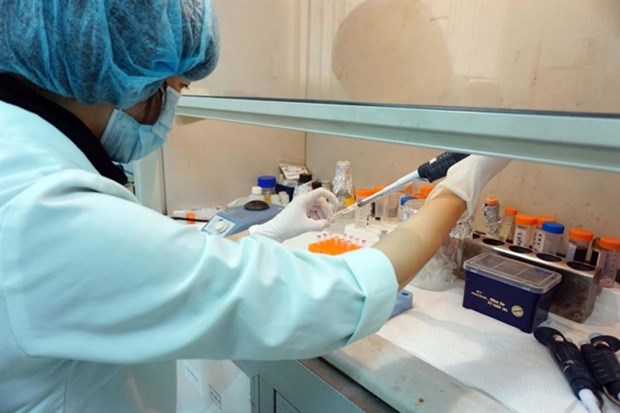
 Illustrative image (Photo: vabiotechcare.com)
university has been transferred to Vietnam which may help lower the cost and
shorten production time.
Vaccine scientists from the University of Bristol are working with Vietnamese
vaccine manufacturer the
() to share cutting-edge knowledge that could help prevent future
global outbreaks of avian flu and rabies.
Vabiotech and the University of Bristol are partners in the Future Vaccine
Manufacturing Research Hub (FVMR Hub), a collaborative initiative led by
Imperial College London and supported by the UK’s Engineering and Physical
Sciences Research Council.
“While rapidly developing countries, such as Vietnam, have an impressive
capacity to manufacture vaccines tailored to local needs, this has historically
been hampered by a lack of access to the cutting-edge innovations in vaccine
technology we specialise in here in the UK,” said Professor Berger, director of
the Max Planck Bristol Centre for Minimal Biology at the University of Bristol.
“Our aim in working with Vabiotech is to share knowledge that will aid and
expedite the development of next-generation vaccines specifically for
deployment in Vietnam,” he added.
Scientists from Vabiotech are being trained by Berger and his team on MultiBac,
a powerful recombinant production technology the Berger team pioneered.
According to Berger,
MultiBac is uniquely suited for producing novel vaccines in large quantities in
insect cells that can be easily cultured at a low cost. The objective is to
master the MultiBac technique and implement the technology in large-scale
biofermenters in Vietnam, he said.
Together with Vabiotech and supported by the FVMR Hub, Berger is targeting the
use of MultiBac towards the production of vaccines for pandemic (avian)
influenza, as well as rabies and other pathogens.
“Vabiotech is particularly interested in using MultiBac to produce vaccines to
combat avian flu. We saw a few years ago how quickly avian flu, which began in
Vietnam, developed into a global threat for humans,” Berger said.
“While the threat of
avian flu in Vietnam still looms, deployment of a suitable vaccine could
therefore help prevent future pandemics,” he said, adding that the new technology
had been used by many major vaccine manufacturers around the world and
successfully developed in more than 1,000 laboratories.
Dr Do Tuan Dat, president and director general of Vabiotech, said that MultiBac
was particularly suitable for the production of new vaccines with large
volumes.
“Vabiotech is aiming to use MultiBac to produce avian flu vaccines and rabies
vaccines, ” Dat said.
He explained that with traditional vaccines, based on virus isolation,
scientists had to cultivate vaccines on monkey kidneys and chicken eggs.
“Using this innovative technology, scientists only need to understand the
characteristics of the virus strain and genome to start growing. The study
period can be shortened to three weeks from the normal level of three months,” Dat
said.
“When a pandemic happens, the demand for vaccines is high. This new technology
will help shorten the research time, improve quality and reduce production
costs,” he said.
According to Dat, the project was in the technological exploration stage and
would take at least three years for the company’s R&D department to develop
it successfully./.
Source: VietnamPlus


