
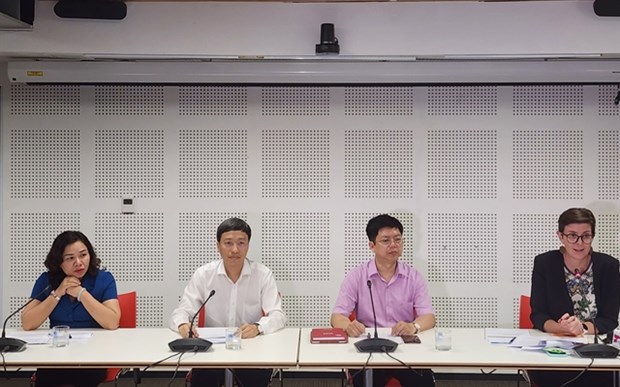
 Vietnamese health experts and World Health Organization (WHO) Representative in Vietnam, Dr Angela Pratt (right), at the press briefing held on Monday. (Photo: suckhoedoisong.vn)
Hanoi (VNS/VNA) – Dr Angela Pratt,
(WHO) Representative in Vietnam, on May 8 said it was too soon to claim that
COVID-19 is just seasonal flu despite similarities between the two viruses.
She was speaking at a press briefing organised by WHO in
collaboration with the Vietnamese Ministry of Health, following ‘s
announcement that COVID-19 is no longer a global public health emergency and
recommendations for future pandemic prevention and control work.
Pratt said: “I always carry a mask with me, which means that
COVID-19 has not disappeared but is always present alongside us.”
She also explained WHO’s statement, which indicated that the
current adaptation level has improved and the severity of transmission
of the disease as well as the number of hospitalisations and severe cases
have decreased.
However, the WHO representative emphasised that this does not mean
that COVID-19 is no longer a threat or any less dangerous.
Asked if COVID-19 could be considered as , she said
that although there are similarities, COVID-19 is not seasonal and has
appeared in many countries and regions at various times of the year.
Therefore, COVID-19 is still a relatively new disease, and people
have only had four years to deal with it, she said, adding that scientists are
still conducting research on the virus.
Pratt also commended Vietnam’s COVID-19 response measures,
particularly the country’s ability to balance pandemic prevention and control
while promoting socio-economic development.
She stressed that this is not the time to relax as the number of
cases is still increasing and there are cases that require special care or even
deaths.
In spite of high herd immunity due to infections and vaccinations,
people still need to be vigilant and take appropriate measures, she said.
In response to questions about recommendations for COVID-19
prevention and control in Vietnam, Pratt suggested Vietnam maintain the
nation’s capacity and prepare for events that may occur in the future to avoid
being overwhelmed.
Secondly, Vietnam should turn the COVID-19 vaccine into the
national vaccination programme as a lifelong vaccination. The country has a
very good COVID-19 vaccination programme, and it should increase booster shots,
especially for high-risk groups.
Thirdly, Vietnam needs to continue to strengthen the monitoring
of respiratory diseases and report activities to WHO. It should focus on
targeted monitoring with any new variants and any changes in the transmission
rate and severity of cases.
Fourthly, Vietnam needs to always be prepared with vaccines,
diagnostic and treatment equipment, and ensure long-term supply chains.
Fifthly, the country should continue disseminating information and
mobilise the participation of community. Communication is still needed to help
people understand and update on the disease.
Vietnam lifted all travel restrictions since last March. However,
it needs to review and update the national response plan and re-establish
public health and social measures based on the pandemic situation and risk
assessment if needed.
Finally, she said, Vietnam must continue studying to improve
vaccines and understand post-COVID-19 conditions./.
Source: VietnamPlus


