

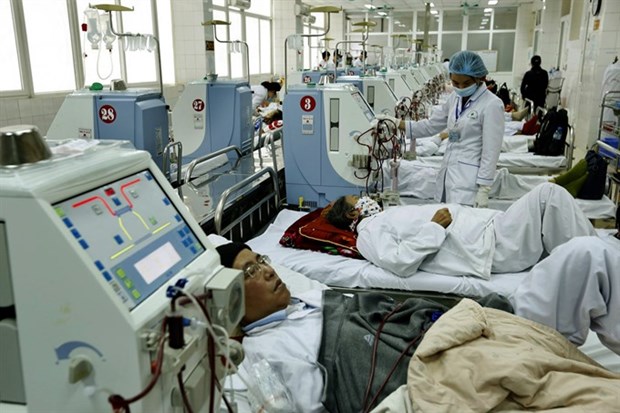
 Hai Duong provincial level general hospital. (Photo: VNA)
Hanoi (VNS/VNA) – Historically, the mostly publicly financed health
care system in Vietnam has only been able to afford to pour resources into a
handful of central level hospitals in big cities, forcing patients living in
remote areas with serious diseases to go to Hanoi or Ho Chi Minh City for
treatment.
Aside from the additional costs for transportation and living, by the time a
patient has reached the central hospital, the ‘golden window’ to best treat
their condition might have closed long ago.
But for the last decade, an initiative called Project 1816 has rotated experts
and professional medical staff from central-level to local-level hospitals,
reducing the in hospitals’ higher administrative units and
improving the quality of medical service delivery in rural areas.
The ‘satellite hospitals’ project has enabled local hospitals to acquire
experience, technology, devices and manpower from central level hospitals. Many
more citizens can now enjoy medical advances right in their hometowns.
December 2017 marks 10 years of implementing Project 1816. So far,
central-level hospitals have sent some 4,000 medical professionals to train
medical staff in local hospitals, while some 4,800 techniques have been
transferred and 2.5 million patients have been treated locally instead of travelling
to big cities, the Ministry of Health said.
From death’s hand
An 85-year-old patient from rural Can Xuyen town of the central province of Ha
Tinh, was admitted to the hospital with severe chest pain, breathing difficulties
and headache.
Dr Nguyen Van Loi, from Cam Xuyen General Hospital’s intensive care unit, said
that since the hospital did not have echocardiography (heart ultrasound)
machine or other advanced monitoring techniques, they could only do basic tests
and ask the patient to rest. The octogenarian patient later went into coma and
her heart stopped beating.
As luck would have it, at the time there was a working group from Hanoi’s
Hospital E, a 50-year-old central level hospital under the Ministry of Health’s
management, visiting Cam Xuyen town, where the local general hospital is
considered a satellite facility.
Doctor Do Quoc Phong, from Hospital E’s intensive care unit, immediately
performed heart reanimation and injected adrenaline into the patient’s veins.
Five minutes later, her heart resumed beating.
Phong said the patient would have had little chance of survival unless
emergency techniques had been applied in a timely manner.
In just three days (January 8-10), Hospital E’s group of doctors blessed
several patients with their professional expertise.
The heart doctor’s table was always crowded, showing locals’ real need for
cardiology care. Meanwhile, both general hospitals of Cam Xuyen and Ky Anh
towns were woefully lacking in doctors and especially in those with an in-depth
knowledge of cardiology.
Because of this, another patient, 53 and also from Cam Xuyen, has not had his
heart thoroughly checked up in the five years since he had his heart operation
carried out in Hue city. Only on this occasion did he have the chance to get
his heart tested carefully and receive plenty of helpful answers.
Hospital E group also noted high demand for treatment of upper respiratory
problems or ENT (ear, nose, and throat) disorder in children, and bone and
joint issues for the elderly.
Hospital E’s deputy director Le Quoc Viet said the working group was deployed
in order to assess the real condition – both in terms of infrastructure and
manpower – in Cam Xuyen general hospital and Ky Anh general hospital. During
this trip, 1,200 patients were treated, including many whose previously
unidentified afflictions were finally diagnosed.
Practical benefits
Professor Le Ngoc Thanh, head of Hospital E, said that the hospital has been
providing assistance to 10 provincial level hospitals (Thai Binh, Thanh Hoa,
Bac Ninh, Bac Giang and Hai Duong provinces, and Hai Phong City), regional
general hospitals like Tinh Gia and Ngoc Lac in the central province of Thanh Hoa,
and two district-level hospitals (Cam Xuyen and Ky Anh).
Most of the expertise is focused on cardiology, injury treatment, intensive
care and poison control, Thanh added.
Thai Binh General Hospital, with the help of Hospital E, will open for the
first time a cardiothoracic (heart and chest) surgery faculty in 2018 to
perform open heart surgery, lung surgery, mediastinal and thoracic surgery –
all of which were impossible before.
Thanh Hoa General Hospital is considered to have mastered most of the
techniques it has received. The central province has invested 34 billion VND (1.5
million USD) to build new surgery theatres and buy new medical equipment to aid
in open heart surgery.
The health ministry said that one of the most significant results of the
satellite hospital project is that it motivates provincial-level hospitals to
upgrade infrastructure and invest in training medical staff, which in turn
brings benefits to patients.
Similarly, Bach Mai Hospital in Hanoi has trained hundreds of doctors in the
remote areas of the northern mountainous province of Yen Bai in many areas of
medicine and skills – diagnostic imaging, gastroenterology, cardiology and
surgery – since it first co-operated with the province under ten
years ago, according to Assoc. Prof. Nguyen Quoc Anh, Bach Mai Hospital’s
director.
Vu Manh Cuong, deputy director of communications and emulation under the health
ministry, said that in the coming years, one priority will be an information
network where surgeries can be live-streamed, and training and education
activities can be done online. The $81 million telemedicine programme, or the
remote diagnosis and treatment of patients by means of telecommunications
technology, part of the Project 1816, will also receive special attention.
In addition, communication works must be stepped up so that local people are
aware of which diseases and conditions can now be handled by local doctors,
hopefully improving the visitation rate, Cuong added. – VNA
Source: VietnamPlus


