

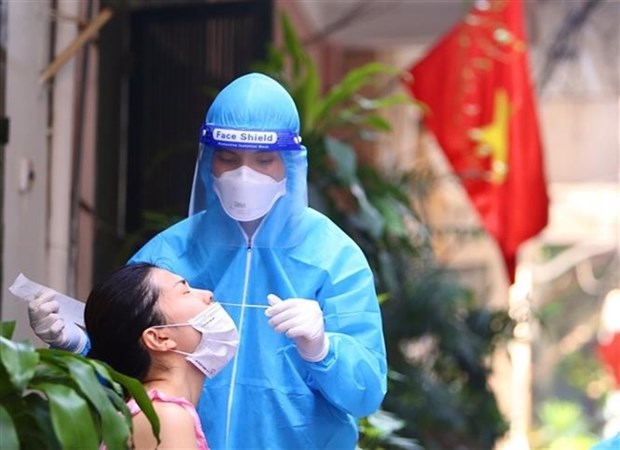
 Sample taken for COVID-19 testing. (Photo: VNA)
 must be tested for SARS-CoV-2 three times a week, while those living in other
areas tested every five or seven days.
This
is part of the latest guidelines sent by the to
steering committees for COVID-19 prevention and control in provinces and cities
nationwide on September 14. The guidelines concentrate on testing and preventive
measures to take when localities implement social distancing.
According
to the ministry, ramping up testing was important to control the disease. In
areas with a high/very high risk of COVID-19 infection, rapid
antigen tests should be given priority to immediately isolate
positive cases.
Rapid
antigen tests and RT-PCR tests could be combined.
In
areas with less risk of infection, pooled testing can be used based on specific
conditions, for example, combining testing samples from people of the same family,
the same building or neighbours.
Under
the guidelines, localities should arrange testing sites for small areas.
Volunteers and people can help take samples for rapid antigen tests.
If
unable to conduct mass testing, areas at high/very high risk must report to the
national steering committee for prevention and control or ask for help
from other areas.
The
Health Ministry asked localities to set up and operate mobile healthcare
stations based in communes/wards which have high/very high risks of infection.
Schools, community houses and offices could be turned into a mobile healthcare
stations so that people could access health services as soon as possible.
Communes,
wards and towns that are under the ‘new normal’ stage must also prepare sites, medical
equipment and staff to use in case their situation worsens.
Authorities
must continuously evaluate COVID-19 risks to decide to impose social
distancing measures or loosen the measures in specific areas. Social
distancing measures must be loosened step by step while screening tests are
maintained.
In
the guidelines, the ministry emphasised that social distancing measures
should be put in place in as-small-as-possible areas, for example, a
hamlet, a residential group or a street.
The
social distancing aims to stop infections and control the disease as soon as
possible – within 14 days.
Social
distancing measures must be implemented strictly. During social distancing, the
supply of food and other essentials for affected people must be ensured.
Medical measures like testing, treatment and vaccination must be conducted
systematically. Measures are also needed to ensure that people can access
health services early, at the grassroots level.
In
the last few months, 23 provinces and cities in Vietnam have implemented social
distancing measures and stricter measures to control COVID-19.
Social
distancing brought positive results in curbing COVID-19 infections.
However,
in some localities, social distancing has been extended due to improper
implementation of measures, a lack of detailed goals, scale and time to apply
social distancing or insufficient testing.
According
to the ministry, the COVID-19 pandemic is developing and may last for a long
time, especially with the presence of the Delta variant which can spread much
easier and faster than the original and other variants./.
Source: VietnamPlus


