

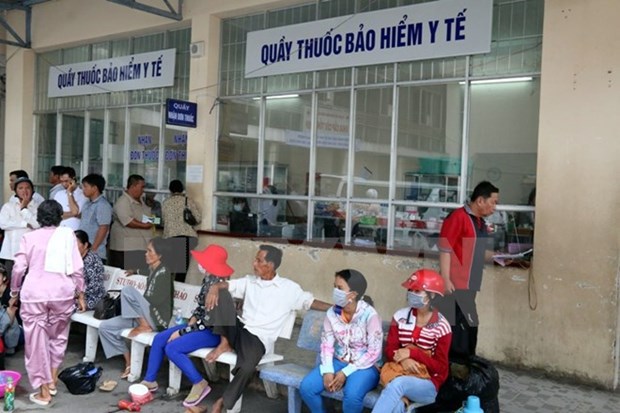
 A new report reveals that widespread fraud by both healthcare institutions and patients have cost some 3 trillion VND (132 million USD) in the first four months of the year (Photo: VNA)
 Hanoi (VNA) – A new
report reveals that widespread frauds by both healthcare institutions and
patients have cost health insurance funds some 3 trillion VND (132 million USD)
in the first four months of the year.
The report, released by (VSS), lists some of the main
tricks used by both healthcare institutions and patients to siphon money from
national and local health insurance funds.
Duong Tuan Duc, Director of the Northern Centre for Health Insurance Review and
Assessment, said that in the first four months of 2017, around 2,800 patients
had more than 50 health examinations, with quite a few of these people having
checks more than 120 times.
In particular, 195 patients who had health checks in four different health
facilities piled up a whopping 7.7 billion VND (338,600 USD) tab, Duc said.
Health care institutions were making up patients’ names for dispensing drugs
and over-prescribing the use of hi-tech equipment like CT scanners, he added.
Nguyen Thi Yen, Deputy Director of the Department of Pharmacology and Medical
Equipment under the VSS, said that a rapid survey of 31 provinces and cities
had detected a big discrepancy of 121 billion VND (5.32 million USD) in drug
procurement thorough bids and purchases in the open market.
Several senior officials have spoken about this issue.
Pham Le Tuan, Deputy Minister of Health, said the abuse of health
insurance increased recently, negatively impacting the people, Health Insurance
Fund and the Social Security Fund.
“I should say that nefarious practices have been resorted to by both people
with health insurance and the health care institutions.
“Many people have cheated by using other people’s health insurance cards. Some
of them have even reused expired health insurance cards by erasing the date and
others have had health checks in many facilities during a short period of time
to get drugs and other medical necessities,” he said.
In several health care institutions, medical practitioners have forged false
medical records to claim financial settlements from health insurance agencies.
To deter such practices, the Ministry of Health has asked all health care
facilities to improve transparency and accountability in providing their
services.
“We have also introduced IT applications in our insurance reviews and
assessments. The applications have helped us detect malpractices,” he
said.
According to the VSS, as of March 2017, the percentage of health facilities
nationwide having their data connected with the VSS was just about 74 percent,
making it hard to verify the accuracy of claims.
Bui Sy Loi, Vice Chairman of the National Assembly Committee on Social Affairs,
said health insurance was a good way for all people to access health care.
“It is undeniable that health insurance has brought about a lot of benefits for
the people,” he said.
He also said that since the introduction of IT in all health care facilities
nation-wide, concerned authorities have been able to track the flow of patients
as well as drugs described.
However, it is also true that many patients and health care facilities have
taken advantages of the imperfect present system to make profits for
themselves, Loi said.
“The MoF should take a close look at what has happened in the financial
settlement for patients using health insurance cards to see if there are any
loopholes or abnormalities in doctors’ prescriptions.
Meanwhile, the VSS has to closely watch and monitor the process to ensure that
funds are used properly.”
Pham Khanh Phong Lan, National Assembly deputy from Ho Chi Minh City, said
the Ministry of Health had not done well as a bridge between the VSS and
the hospitals.
She said a major part of the problem was that people participating in health
insurance schemes made modest contributions, but wanted to extract much higher
benefits.
In addition, the health insurance management mechanism between
centrally-managed cities and provinces was quite different. For example, Ho Chi
Minh City, a centre for hi-tech applications and a place where serious cases
from other localities are referred to, had an annual health insurance fund that
always enjoyed surplus. This was attributed to efficient performance of the
municipal health insurance fund. In most localities, however, health insurance
funds were always in deficit.
“Another point I want to mention is the doctors’ drug descriptions. Though
under the Circular 11, the Ministry of Health, prohibit doctors from
prescribing brand name drugs for their patients, many doctors still do so. This
is one of the reasons costing the insurance fund. Only in special cases should
doctors prescribe brand name drugs for their patients.”-VNA
Source: VietnamPlus


