

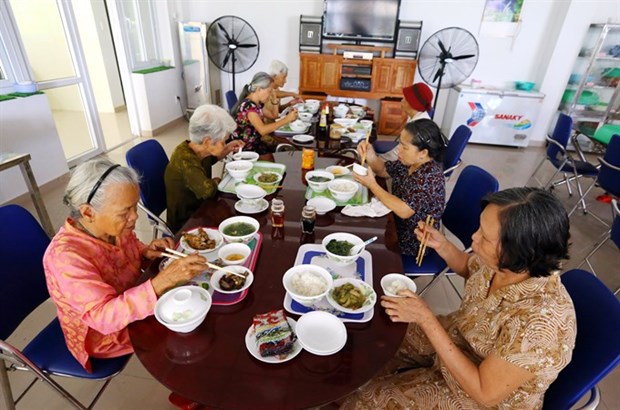
 Elderly people have a meal at a nursing home in Da Nang. (Photo: VNA)
Hanoi (VNA) – The Vietnamese are eating a lot of
salty food. However, many people refuse to accept that excess salt in one’s
daily diet is not healthy and may cause several non-communicable diseases
(NCDs) such as high blood pressure or heart diseases, participants heard at a recent
workshop.
Speaking at the event, National Institute of Nutrition (NIN) Vice
Director Prof. Truong Tuyet Mai said fatalities caused by NCDs are increasing
in Vietnam.
Mai said Vietnam reported 520,000 fatalities in
2012, of which nearly 400,000 deaths, equivalent to 73 percent, were caused by
NCDs. In 2017, deaths caused by NCDs have reached up to 411,000, making up 76
percent of total fatalities. Fatalities caused by heart diseases are 33
percent, followed by cancer at 18 percent, Chronic Obstructive Pulmonary
Diseases at seven percent and diabetes at three percent.
The situation is caused by many factors, especially the high
rate of smoking, overweight, lack of physical exercise, high blood pressure and
eating fewer vegetables.
Le Bach Mai, an NIN nutrition expert, said salt intake of
over 5g per day may be harmful for people’s health, according to the World
Health Organisation (WHO) recommendation.
“A bow of pho noodle has 3.4 to 4.6 grams of salt. It means
that by eating just breakfast, you have completed the daily salt requirement
for one’s body,” Mai said.
Mai suggested people reduce daily salt intake for NCD
prevention by reducing salt in home food, eating fresh food and vegetables and
minimising the use of processed and braised food.
Do Thu Hien, a housewife in Hanoi’s Hoang Mai district, said
her family is used to eat salty food.
She said she was aware that excess salt intake was not good
for people’s health. However, Hien and her family had trouble reducing their
intake of salty food.
“We usually add more salt to food when we cook at home. We
also add fish sauce to food we eat every day,” Hien said.
She said she would try to reduce salt in the food her family
eats.
“A person just needs 1-2g of salt per day. However, a
survey in 2015 showed that a Vietnamese person consumed up to 9.4g daily,
nearly doubling the recommendation level of WHO,” Lai Duc Truong, an expert
from the organisation in Hanoi, said.
“Salt intake of Vietnamese has reached up to nearly 10g per
day. This will lead to NCDs related to high blood pressure, stomach cancer,
kidney failure and asthma,” Truong said.
He said 77 percent of salt intake in developed countries
comes from processed and restaurant food, in comparison with 20 percent in
Vietnam.
“Some 70 percent of salt intake comes from home cooking and
10 percent is added to food while eating in Vietnam,” Truong noted.
WHO has said reducing salt intake to less than 5g per day
will save 2.5 million lives every year, according to him.
Vietnam has set a plan to reduce 30 percent of salt intake in
the daily food ration of Vietnamese people to 6.6 grams per day by 2025 to
reduce risks of NCDs such as diabetes, high blood pressure and cancer. The move
is a part of efforts to achieve nine global targets set by WHO to prevent NCDs
from now to 2025.-VNA
Source: VietnamPlus


