

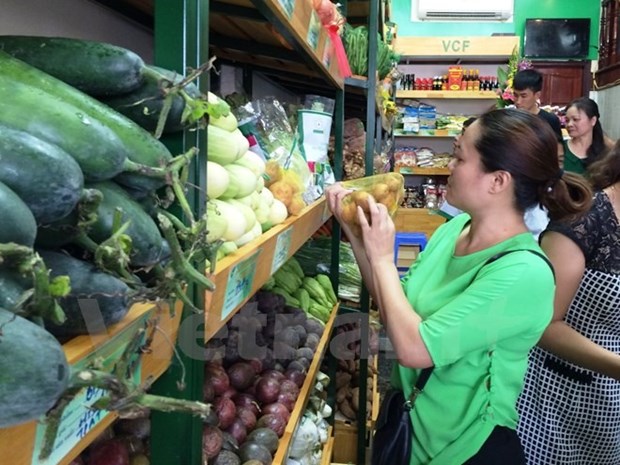
 A customer looks at potatoes at a safe food store of the Vietnam Cooperative Alliance. (Source: VNA)
management and high prices prevent many citizens from accessing safe food
as Tet () approaches.
Food demand rises by 20 percent this time of
year, creating opportunities for unsafe food to enter the marketplace.
Forty-five localities in the country are
collaborating with 380 s to deliver safe vegetables, fruits, meat,
eggs, rice and seafood. However, developing safe food supply chains and
providing citizens with safe food has been a struggle.
Food has only touched the tip
of the iceberg in terms of market supervision and does not cover the production
phase.
Only 0.6 percent of slaughterhouses in the
country are legally operated, far from residential areas, and meet the
hygiene standards for food safety. In other words, most of the food sold is not
controlled.
Inspections by the Hanoi Department of
Agricultural and Rural Development showed that several vegetable products
labeled as “safe” at supermarkets and trade centres had not been certified by
specialised authorities, said Nguyen Thi Hang, deputy chief inspector of the
department.
In 2016, the department confiscated and
destroyed thousands of tonnes of uncertified “safe” seafood, beef, pork and
buffalo meat at credible stores, she said.
Some 1,800 agricultural products are being sold
at 142 distribution stores a year after developing a vegetable and meat supply
chain for the capital’s citizens, according to Chu Phu My, director of the
agricultural department.
However, the price of safe food is often much
higher than uncertified food, making it difficult to sell. A number of
distribution stores closed down after struggling to sell the safe food.
To have stable quality, good service and
reasonable prices and maintain their businesses, several owners of
stores said that the Government should give them preferential tax policies and
pricing support, as well as developing safe agricultural models and applying
measures to control food from production to distribution.
Tran Manh Chien, owner of the safe food
brand Bac Tom, said that authorities need to increase inspections of
agricultural products sold at supermarkets and trade centres.
Agricultural co-operatives and farm owners
should inspect food quality at their outlets, he added. They should end
contracts with the outlets and report to the authorities if they detect unsafe
food in the stores labeled as safe food brands, he said.
Few State agencies have done a good job of
marking unsafe food violations and violators.
The Hanoi-based Centre for media in Educating
Community (MEC) reported at a talk on food safety that until this month, only
seven of 31 websites of agencies responsible for the issue publicised lists of
food violations and violators.
According to the Law on handling administrative
violations, food safety violations–as well as a litany of other
violations–with serious consequences or bad social impact must be publicly
broadcast by relevant agencies.
The public notifications must be made on the
websites or newspapers of ministerial -level or provincial department-level
management agencies or the provincial –level People’s Committees of localities
where the violations are committed.
Speaking at the discussion organised by MEC and
the People and Nature Reconciliation (Pan Nature), lawyer Tran Thu Nam said
that there had neither been sanctions nor punishments for State agencies that
did not publicise food-relating violations on their websites.
Meanwhile, public notifications could be a
punishment stronger than any administrative fine to violators, as notoriety
could hurt business, he said.-VNA
Source: VietnamPlus


