

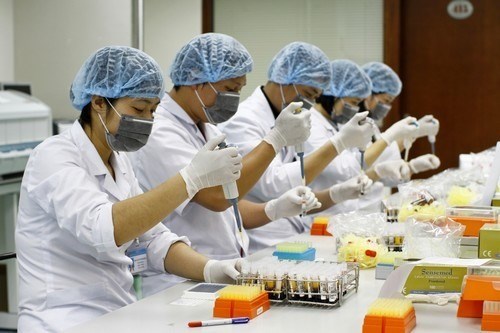
 Health workers work at a laboratoty of the National Institute of Haematology and Blood Transfusion in Hanoi (Photo: VNA)
Hanoi (VNA) – Nguyen Thi Lua, 54, a homemaker in Hanoi,
was detected with leukaemia at Saint Paul Hospital where she had registered for
a check-up, funded by health insurance.
Once
diagnosed with blood cancer, Lua was sent to the National Institute of
Haematology and Blood Transfusion (NIHBT) for treatment. However, at the NIHBT,
the highest medical facility that specialises in blood diseases, doctors
refused to use the results of the tests conducted at Saint Paul Hospital.
Lua was
forced to spend another half a day undergoing tests that she had done just a
few days ago. The only good thing is that the health insurance fund will pay
for tests conducted at both hospitals.
Lua is
among the thousands of patients who have to repeatedly undergo the same medical
tests as they are sent from a hospital to a higher-level or more specialised
medical facility. While it’s a waste of valuable time for patients and health
workers, it’s a waste of money for the health insurance fund.
However,
from 2018, hospitals and medical facilities of first and special levels will
start recognising and using patient examination and treatment test results from
other such facilities.
Nguyen Trong
Khoa, deputy director of the health ministry’s Medical Service Administration
(MSA), said that there are currently 50 ISO-15189 compliant medical
laboratories in 40 central and provincial hospitals that will start
implementing the mutual recognition plan from July this year.
“Mutual
recognition of test results means a hospital recognises test results from
others in several cases when tests still have usage value and depending on the
patient’s condition,” said Luong Ngoc Khue, director of the MSA, while speaking
at a workshop in Hanoi last week.
“This
means that some test results may be used by other hospitals or medical
facilities for patient diagnosis, treatment and supervision that will help save
test expenses.”
The
workshop on implementing the national laboratory quality management criteria,
for , was aimed at handling issues faced when
hospitals or medical facilities don’t recognise test results.
Khue said
that by 2020, all medical tests conducted by certain laboratories can be linked
and accessed by all hospitals and medical facilities in the same city or
province. By 2025, this information-sharing model will be nationwide.
According to the health ministry, the country’s
hospitals conduct roughly 475 million tests, including 200 million blood tests
and 25 million microbiological tests annually, at a growth rate of 10 percent
each year. Reducing even one percent of the country’s total tests would reduce
around 4.75 million tests annually, Khue said.
“If a test costs 50,000 VND (2.2 USD), we could
save 237.5 billion VND of the fund.”
The
health ministry has developed criteria required for biochemical, blood and
microbiological tests that will be applied across laboratories. These will lay
important foundation for hospitals and medical facilities to mutually recognise
and use test results, Khue said.
The
ministry will also tighten inspection and supervision on test prescription
processes in hospitals to prevent overuse of tests, Khoa said.-VNA
Source: VietnamPlus


