

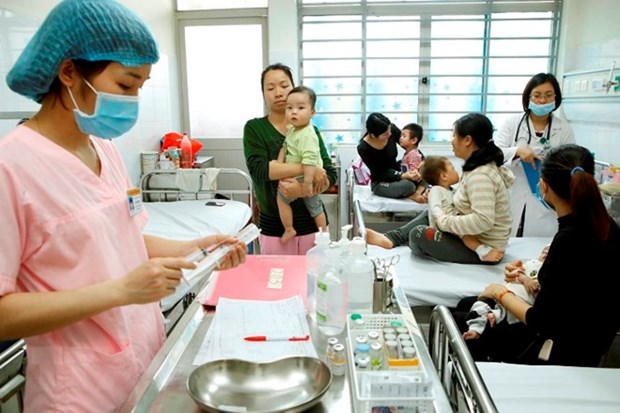
 A patient room at the Vietnam National Children’s Hospital in Hanoi (Photo: VNA)
Hanoi (VNS/VNA) – Hospitals and
clinics in Vietnam have started implementing surveillance of nosocomial
infections and monitoring the hospital-infection control process, Deputy
Minister of Health Nguyen Viet Tien said at a recent meeting.
Measures include the monitoring of hand hygiene
compliance, hospital microbial surveillance and antibiotic resistance, step by
step standardisation of disinfection, hospital hygiene improvement, and disease
prevention, Tien said at the meeting organised by the Health Ministry in Hanoi
this week that aimed to implement the new Circular on hospital-infection
control regulations.
The Ministry of Health has just issued Circular
No.16/2018 that regulates , to replace the previous
Circular No.18/2009.
Director of the Ministry of
Health’s Medical Examination and Treatment Department Luong Ngoc Khue said according to the new circular,
hospitals with over 150 beds must have a hospital-infection control
department, and hospitals with under 150 beds must have an infection control
office with full-time staff.
“The head of the hospital must
be fully responsible for hospital-infection control plans,” Khue said.
“Full-time supervisors,
disinfectants and sterilisers must have Ministry of Health certificates or
degrees in hospital-infection control (with training time of three months).”
Khue added the new circular
also suggested hospitals seek investment and funding from different sources to
develop hospital sanitation measures and waste treatment under the professional
control of the hospital-infection control department.
“The circular is an important
step to determine hospital-infection control work as a key task of the health
sector.”
However, Deputy Minister of
Health Nguyen Viet Tien acknowledged that the work of hospital-infection
control in Vietnam still faced many challenges.
At some clinics, management has
not yet fully understood the role and importance of hospital-infection control
work, so investment has not been appropriate or effective, according to Tien.
“Human resource management for
hospital-infection work is inadequate and weak in contributing to the effective
prevention and control of antibiotic resistance, medical complications, and of
contagious disease,” Tien said.
In particular, with the
development of diseases in developing countries, including Vietnam, infectious
diseases accounted for a high proportion with many newly-emerging diseases
bringing a high risk of death, occurring not only in communities but also in
hospitals, such as influenza A (H5N1, H1N1, H7N9), MERS-CoV and Ebola,
according to the deputy health minister.
This was one of the major
challenges facing the health sector’s hospital-infection control work.
According to the Ministry of
Health, the ratio of patients suffering from hospital-acquired infections in Vietnam
ranges from 4-8 percent of total patients being treated at hospitals.
In fact, there have been a
number of wide-spread cases, including the measles outbreak in 2014 that
infected many children being treated at the Hanoi-based National Hospital of
Paediatrics.
In November, 2017, a hospital-acquired
infection case at the Bac Ninh obstetrics and maternity hospital killed four
babies, and many others were infected with various levels of severity.
In June 2018, many children in
Dien Bien Dong district in the northern mountainous province of Dien Bien were
also infected with measles after being treated at a district health clinic.
There are many risks of
infection in hospitals, including from drinking water, toilets and medical
equipment. To ensure the hygiene and safety of patients, many hospitals have
installed soap, clean bed sheets and toilets to prevent infections.
Nguyen Tan Hoa, 54, from southern
Dong Nai province, was taking care of his wife, a cancer patient at HCM City
Tumour Hospital, saying “There are free water bottles, which is good for
patients and their family members. But in a crowded hospital, with all kinds of
sickness, bottles should be cleaned thoroughly.”-VNS/VNA
Source: VietnamPlus


