
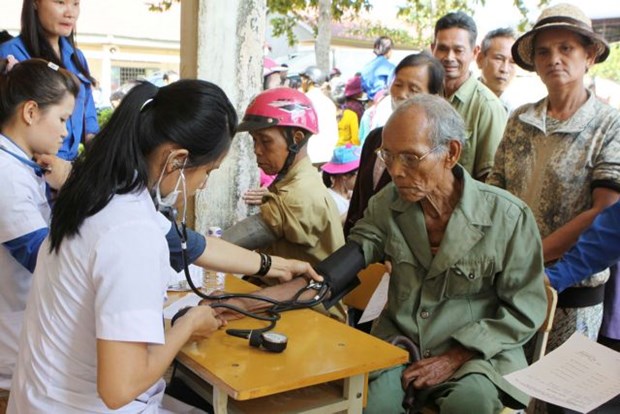
 Residents in Ea Yong Commune in the Central Highlands province of Dak Lak’s Krong Pak District receive free health check-ups(Photo: VNA)
Hanoi (VNS/VNA) – On February 27, 1955, late
President Ho Chi Minh sent a to a conference of
across the country. The 368-word letter asked for three things: to stay
honest and united, love patients, and devoted to developing the country’s
healthcare sector. Since then February 27 has been known
as Vietnamese Doctors’ Day.
Over the past 65 years, Vietnam’s health sector has striven to fulfill the
task of protecting people and made increasingly active contributions to
the development of global medicine.
Vietnam has gained a significant reputation worldwide as a bright spot for
the implementation of UN Millennium Development Goals (MDGs). The network
of preventive medicine, medical examination and treatment facilities,
manufacture and supply of pharmaceuticals, medical insurance, and professional
capacity of medical staff have all developed.
Brilliant achievements
Since the country’s reunification on April 30, 1975, the health
sector has made great strides and important achievements in the care and
protection of people’s health.
Regarding the fulfilment of the MDGs, Vietnam has been able to eradicate
polio, and control neonatal tetanus, pertussis and diphtheria. Vietnam has
maintained an immunisation rate of more than 95 percent for children under one,
pregnant women and women of reproductive age. The rate of malnutrition
among children under five decreased from 30.1 percent in 2000 to 13 percent
in 2018. The rate of stunting malnutrition also decreased from 36.5 percent in
2000 to 23.3 percent in 2018.
According to a UNICEF report, Vietnam had made impressive progress in
reproductive health and maternal and child health. With a four-fold decrease in
the maternal mortality rate and a sharp drop in the under-five mortality rate,
the report said Vietnam’s maternal and child health indicators were superior to
other countries.
The health sector has reportedly kept HIV/AIDS prevalence in the community
below 0.3 percent, and also reduced the number of new infections, and is
continuing to expand drug dispensing facilities.
Over the last 30 years of implementing epidemic prevention and control, Vietnam
has built up a capacity to monitor, detect, diagnose, identify diseases
and respond quickly and effectively. The country’s capacity to prevent
dangerous and emerging diseases has been improved, as has treatment.
Preparations to cope with dangerous diseases have also been put in place.
As a result, many dangerous epidemics have been controlled, repelled and
eradicated, such as smallpox in 1978, polio in 2000 and neonatal tetanus in
2005. Since 2002 there have been no cases of plague. Some epidemics could
have been hundreds or thousands times worse had it not been for the
expanded vaccination programme that started in 1981, such as diphtheria,
whooping cough and measles. Other circulating epidemics such as
dengue fever, viral encephalitis, tuberculosis, typhoid and cholera have
also been controlled.
Vietnam is also one of the first countries to successfully control SARS, A/H5N1
flu and A/H1N1 flu, and prevent a number of emerging dangerous
epidemics such as influenza A/H7N9, Ebola and MERS-CoV.
Vietnam has a strong monitoring capacity. All emerging infectious diseases
have been stemmed, including MERS-CoV, Ebola, influenza A/H7N9 and the
on-going COVID-19. Effective infectious disease surveillance results from
community supervision, and supervision at border gates and in laboratories.
Grassroots health network
Over the years, the grassroots health network in Vietnam has
been strengthened and developed. Vietnam is internationally regarded as one of
the few countries with a comprehensive and organised health network.
Currently, there are more than 700 district-level health centres, more than
11,100 commune-level health stations, of which more than 60 percent meet the
national criteria. 100 percent of communes have health stations or
inter-commune general clinics. 87.5 percent of commune health stations have
doctors working (including both long-term and senior physicians, who alternate
between two and three days a week). 96 percent of commune health stations have
a midwife or obstetrics-paediatrics assistant doctor, and over 95 percent of
villages have health workers or midwives.
There are now more than 1,400 hospitals and 180,000 beds nationwide,
where 10 million people are treated each year and 2 million complicated
surgeries are performed.
Vietnam is recognised as one of the few countries to master vaccine production
technology, including three types of seasonal flu vaccines manufactured
and registered for commercialisation. Biotechnology has been applied in the
screening and diagnosis of measles, dengue fever and hand-foot-mouth disease.
The country has also mastered
and improved many world-class medical techniques, and transferred advanced
techniques for diagnosis and treatment such as laparoscopic surgery,
cardiovascular intervention and diagnostic imaging. The country is also now an
expert in assisted reproduction, treatment of blood cancer, myocardial
infarction, bone-joint disease, burns and plastic surgery. Stem cell
applications in the treatment of blood diseases have also been applied. The
national health system has 15 facilities for heart, kidney, liver, corneal
transplants, and haematopoietic stem cell transplants.
In October last year, two successful lung transplants marked a new feat in Vietnam’s
organ transplant capacity, after the country conquered the world’s most
difficult transplant technique in 2018. In addition to conventional techniques
for heart, liver, kidney, bone marrow and corneal transplants, Vietnam has
confirmed its mastery of multi-organ transplantation.
In the field of obstetrics, Vietnam has also been successful with fetal
intervention technology, which is the most modern technology in fetal medicine
today. Last year, the Hanoi Obstetrics and Gynecology Hospital was the first
public hospital to successfully implement this technique, successfully
intervening for nearly 20 pregnant women with twins and twin-twin
transfusion syndrome. The first baby to receive fetal intervention due to the
syndrome was born healthy on December 14. The fetal intervention technique can
intervene in most fetal organs, even the brain, heart and pleura and is
considered humane, increasing the chances of saving lives for pathological
fetuses.
Health care goes hi-tech
In the Fourth Industrial Revolution and global medical
technology, the Vietnamese health sector has prepared and implemented a number
of smart health applications and development activities, contributing to the
modernisation of medical services, protection, care and improvement of people’s
health. The sector also expects to attract foreigners, Vietnamese living abroad
and Vietnamese people with high incomes, to enjoy high quality medical care and
treatment in Vietnam from 2020-30.
This , there will be no celebration as the Ministry
of Health has ordered its departments in 63 provinces and cities to focus on
fighting the COVID-19 epidemic.
At an online conference on the prevention and fight against the
COVID-19 epidemic on February 25, Deputy Prime Minister Vu Duc Dam asked
delegates at the Ministry of Health and more than 700 online points to take
one minute to thank the health workers who laid down their lives and those
who died during the 2003 SARS epidemic.
He said even without flowers to celebrate Vietnamese Doctors’ Day,
everyone should still thank their doctors.
“On February 27, we are grateful to the generations of physicians who
sacrificed themselves for the cause of national liberation and unity, and protecting
the health of the people, including those who died during the SARS pandemic in
2003,” Dam said.
“They have left us with valuable examples and lessons,” he said./.
Source: VietnamPlus


