

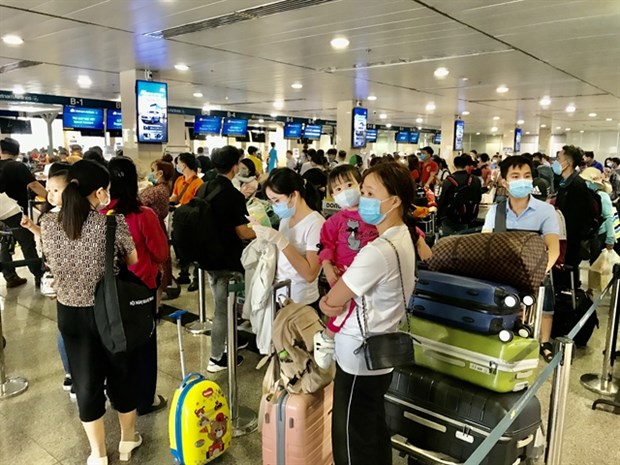
 Passengers at the domestic terminal at Tan Son Nhat International Airport in HCM City ahead of the Lunar New Year holiday. (Photo: VNA)
HCM
City (VNS/VNA) – ’s authorities are testing
arrivals from three major airports in the north (Noi Bai in Hanoi, Van Don
in Quang Ninh province and in the northern port city of Hai Phong) as
tens of thousands of passengers are returning after the Lunar New Year holiday.
According
to the (CDC), as of
February 14, some 200 samples had been taken each day for testing on
a random basis at Tan Son Nhat International Airport in HCM City.
The
move is part of the city’s effort to monitor cases. Four
hospitals, including Nguyen Tri Phuong, Ear Nose and Throat, Hung Vuong, and
Traditional Medicine, have participated in the screening.
Since
February 11, the city has also tested people considered at high-risk of
contracting the virus at bus stations, wet markets and some rental housing
units in order to monitor the risk in the community.
In
addition, the HCM City CDC has been conducting testing at hospitals
across districts since September 15.
To
ensure safety for passengers at Tan Son Nhat, airport staff must be
tested one day before their working shifts.
More
than 1,600 families of employees of the Vietnam Airport Ground Services
Company Limited (VIAGS) have also been asked to test, as of
February 10.
The
main cluster of cases at the airport was related to VIAGS.
Source of infection
According
to the HCM City-based Hospital for Tropical Diseases, the virus strain (A.23.1)
associated with the Tan Son Nhat airport outbreak was first found in
the African country of Rwanda in late October.
This
is the first time that the Rwanda variant has appeared in Vietnam and
Southeast Asia. It is not the highly contagious UK variant (B.1.1.7) or
the variant detected in South Africa.
The
Rwanda variant has been discovered in a few other countries such as the
US, the United Arab Emirates (UAE), Australia, and several countries in Europe,
including the UK and Denmark. However, no “abnormal developments” have
been reported in those countries.
Based
on an analysis, experts believe the Rwanda variant is likely to
have infected the staff at Tan Son Nhat airport through cargo flights.
Dr.
Phan Trong Lan, Director of the HCM City Pasteur Institute, said: “The most
likely hypothesis is that the strain originated from cargo flights from
the United Arab Emirates.”
Cargo crew
members are not subject to quarantine and testing because they are not allowed
to get off the plane, he added.
During
this period, flights from the United Arab Emirates arriving at the Tan Son
Nhat airport were possibly the source of infection for the loading
staff on the ground, who had contact with aircraft crew members.
Lan
noted, however, that the risk of infection from outside the airport cannot
be ruled out, but it is unlikely to be the source.
According
to the HCM City CDC’s initial assessment, most of the patients related to
the Tan Son Nhat outbreak had no symptoms or very mild symptoms. Many cases
have tested negative quickly after a few days of treatment at
hospitals.
The
centre said it would work with experts to collect data on epidemiology,
clinical signs, antigens, antibody test results, and sequencing genes to learn
further about the cases.
Since
the first case was detected at the airport, the city has recorded 36
COVID-19 cases as of February 16, including 10 patients who are loading
staff at the Tan Son Nhat airport and 26 cases who are family members of the
loading staff.
City
authorities have imposed a strict lockdown on areas that are related to the
cases. All non-essential services and entertainment, and cultural and sports
activities have been suspended until further notice.
“The
infection chain at Tan Son Nhat hotspot has basically been
contained,” according to the HCM City CDC.
The
city is continuing to conduct extensive screening in the community to assess
the risk of disease./.
Source: VietnamPlus


