

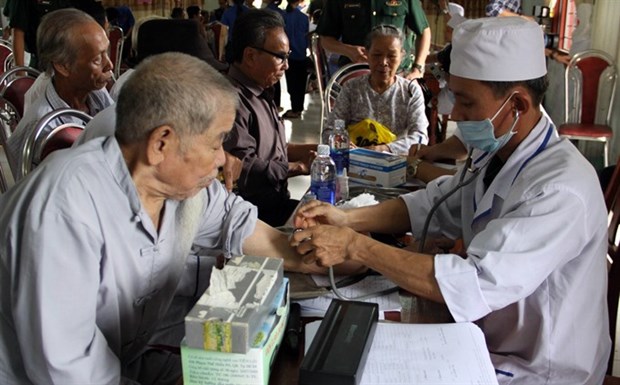
 Medical workers treat residents in Hai Chanh commune in the central province of Quang Tri. (Photo: VNA)
Hanoi (VNA) – The quality
of grassroots-level healthcare facilities nationwide has yet to meet
expectation and patients’ demand, said Minister of Health .
It is not necessary for most
patients to go to central hospitals when their illnesses can be treated at
lower-level health facilities, she said at a meeting last weekend on improving
ward-level clinics.
“Up to 35.4 percent of patients
who go to can be treated at provincial and district
level hospitals. As many as 41.5 percent who go to provincial hospitals can be
treated at district-level and 11 percent can be treated at
ward clinics,” she said.
Grassroots-level healthcare facilities have not
fulfilled their tasks of taking care of people’s health. Local health
facilities are able to conduct an average of only 68.3 percent of medical
techniques among 76 services. Facilities of the lowest quality can perform less
than 20 percent of the services.
There are a limited number of
medicines covered by health insurance at the grassroots level. Some types of
medicines are not even available, she said.
Doctors at ward clinics are not
allowed to prescribe medicine for high blood pressure and diabetes. Only
district and provincial level hospitals can do so. A number of clinics do not
have doctors. For these reasons, patients do not choose grassroots healthcare
services, she said.
Twenty-six clinics in wards and
towns of eight cities and provinces have been selected to implement a pilot
programme by the health ministry on improving the quality of grassroots-level
healthcare. However, most of the clinics need to upgrade their infrastructure
and medical equipment to effectively implement the programme.
Tien said that among those
selected clinics for the trial period, only healthcare facilities in Hanoi, Ho Chi
Minh City and northern Yen Bai province have enough doctors. Other localities suffer a shortage of doctors
and traditional physicians.
The health minister said that the key healthcare
facilities in the programme will be equipped with beds, drug cabinets, X-ray
machines, ultrasound and testing machines if necessary.
To address the shortage of
doctors, staff will be rotated to work at each clinic for two to three days a
week. Nurses and physicians will be moved to balance the numbers while
administrators at the local clinics will be professionally trained, she said.
In the 2018-20 period, the
health minister will send professional healthcare workers from central
hospitals and facilities in Hanoi and HCM City to
assist ward and town clinics in disadvantaged areas including Lao Cai province’s
Bat Xat district, Yen Bai province’s Tran Yen district, Ha Tinh province’s Huong
Son district and clinics in the capital city’s suburban areas like Ba Vi, Dan
Phuong, Ha Dong, Nam Tu Liem districts.-VNS/VNA
Source: VietnamPlus


