
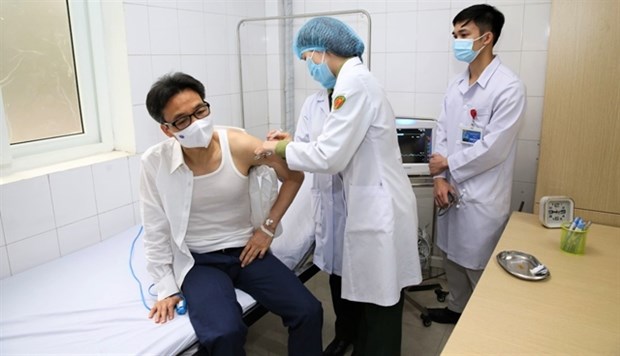
 receives Nano Covax, Vietnam’s own vaccine, on March 26 as part of the vaccine’s second phase human trials. (Photo: vov.vn)
Hanoi (VNS/VNA) – Deputy Prime Minister Vu Duc Dam and Deputy Minister of
Science and Technology Pham Cong Tac on March 26 received the jabs of Vietnamese-made
COVID-19 vaccine, Nano Covax, as part of the second phase of human trials.
Dam, 58, is the head of the National Steering Committee for COVID-19 Prevention
and Control, and Tac a science official. They both underwent medical check-ups
before receiving the shot at the Vietnam Military Medical University in Hanoi.
After the inoculations, Dam and Tac remained at the injection room for
follow-up observation for 30 minutes, before he visited and thanked volunteers
who were at the university for the second jab in the trials during March
25-April 6, as well as giving words of encouragement to the vaccine developers.
The volunteers were given the first jab between February 26 and March
9.
Nano Covax, developed by HCM City-based biopharmaceutical company Nanogen, was
the first vaccine made by Vietnamese scientists to enter clinical trials.
Dam expressed his pride and confidence in the scientists of Vietnam, adding
that in the future, the public will be able to receive the COVID-19 vaccine
shots for free in the framework of the National Expanded Programme on
Immunisation.
He stressed that all agencies and people involved in the research and
development of locally made vaccines must expedite the progress, but no corners
should be cut.
Professor Do Quyet, Director of Military Medical University, said the results
of the first phase trial showed Nano Covax is safe and enabling the body to
generate antibodies that can neutralise coronavirus, including the highly
contagious variant first reported in the UK (B117).
The second phase involves a larger number of volunteers (560 people between
18-60 years old including people with some mild or early-stage chronic
conditions) and the focus shifts to the effectiveness and immunogenicity of the
vaccine, according to Quyet.
The volunteers are divided into four groups, 80 are injected with a placebo,
and the rest are given different doses – 25mcg, 50mcg, and 75mcg to test dosage
level.
After the end of the trials, the people given the placebo will be injected with
the real vaccines.
With the current progress, by the end of June-early July this year, scientists
can propose to the national committee for ethics in biomedical research to
allow commence of phase 3 trials and greenlight experimental injections on a
wider scale, he continued.
According to the expert, WHO noted that the vaccine should be evaluated on
whether it could provide protection for the people in an environment with
community infections.
In the phase 3 trials, scientists will need to test the vaccine on 10,000
people – 5,000 people to receive Oxford/AstraZeneca COVID-19 vaccines, and
5,000 to receive shots – to compare the two vaccines’ side effects,
immunogenicity and the ability to fight the virus.
With this approach, Quyet believes that by September this year, Vietnam could
have its first commercial COVID-19 vaccine./.
Source: VietnamPlus


