

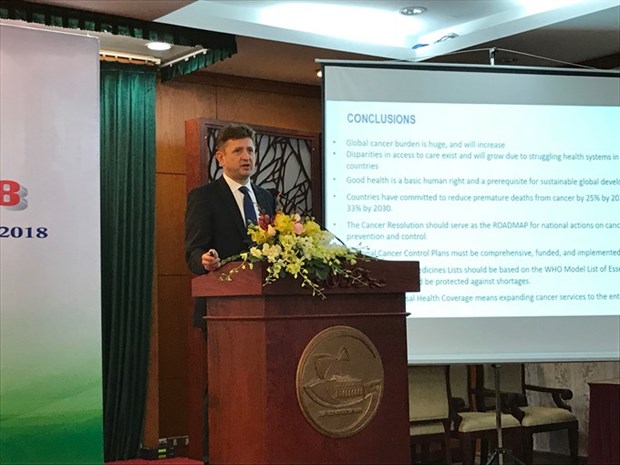
 Dr. Alexandru Eniu of the European Society For Medical Oncology’s executive board speaks about the global aspects of cancer at a scientific conference held by HCM City’s Thu Duc District Hospital on November 21. (Photo: VNA)
HCM
City (VNS/VNA) – (NCCPs) must be
comprehensive and funded since the is huge and would
increase, Dr ’s
executive board has warned.
acknowledge cancer as a diverse group of different diseases requiring
specific patient management, he told an annual scientific conference held at
the Thu Duc district Hospital on November 21.
They promote cancer research and the use of cancer statistics to determine
national priorities and epidemiological specificities, and set the objectives,
goals and targets for cancer control, he said.
The plans work for the prevention of the four main lifestyle risk factors for
cancers, tobacco, alcohol, obesity, and physical inactivity, he said, adding
that they would support primary care health providers in the early detection of
cancers, he said.
But they require multi-stakeholder engagement to develop, implement and
operationalise successful and effective cancer control strategies and turn
policy commitment into effective action, he said.
Stakeholders include public and private hospitals, NGOs and academia.
“Good health is a basic human right and a prerequisite for sustainable global
development.
“We are currently experiencing a cancer epidemic,” said Dr. Eniu.
The International Agency for Research on Cancer’s 2018 GLOBOCAN report showed
the new cancer cases world-wide had risen to 18.1 million, including 9.6
million deaths.
Cancers of the lung, breast, colorectal, prostate, and stomach were the most
common among them.
Dr Nguyen Trieu Vu, head of the Thu Duc district Hospital’s oncology
department, said Vietnam has 164,000 new cases each year and cancers kill
114,000 people every year.
“Cancer patients in the country are diagnosed late and do not have access to
[proper treatment].”
Eniu said 90 percent of patients in low- and middle-income countries lack
access to radiotherapy.
“Only 5 percent of patients in low-middle-income countries and 20 percent in
middle-income countries have access to safe, affordable and timely cancer
surgery.”
Disparities in access to care exist and would grow due to struggling health
systems in emerging countries, he said.
Prevention is not enough and treatment is essential, he said. Secondary care is
necessary, he said.
Inexpensive medicines treat nearly 80 percent of cancers, he said.
Dr Le Tu Phuong Chi of the Tu Du Obstetrics Hospital’s gynaecological oncology
department said the Department of Maternal and Child Health has developed a
national action plan for prevention and control of cervical cancer
by 2025.
The plan identifies targets based on domestic and international orientation,
enhances the availability and quality of treatment and increases the level of
service utilisation through communication and health education, she said.
It aims to ensure all provincial and city hospitals can conduct cervical
cytology and analyse the results of the cervical samples, 90 percent of
district hospitals can do the test and 70 percent of commune health stations
can do visual inspection with acetic acid for screening.
It also targets 60 percent of women aged 30 to 54 being screened for cervical
cancer.
“Most cervical cancer cases can be prevented by screening, early detection and
treatment of precancerous lesions or the detection and treatment of early
invasive cancers,” Chi said.
The conference also heard presentations on cardiovascular treatment and others.-VNS/VNA
Source: VietnamPlus


