

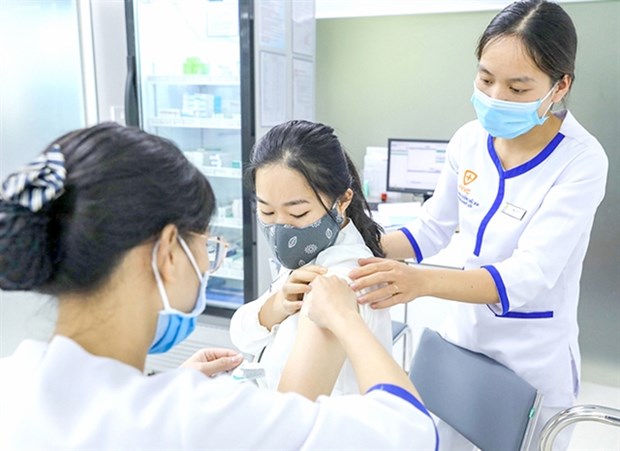
 A woman receiving an HPV vaccine. (Photo courtesy Vietnam Vaccine Centre)
Hanoi (VNS/VNA) – The number of women with cervical cancer is
increasing in Vietnam, health experts warned.
According to the (WHO), more than
500,000 new cases are reported and about 250,000 women die from
each year globally.
If there were not proper , by 2030, the
number of cases globally will reach 700,000 and 400,000 deaths.
Meanwhile, each year Vietnam has about 4,177 new cases and
2,420 deaths due to this disease.
About 37 million women aged 15 years and older are in
the high-risk group for cervical cancer, ranking third among cancers among
women aged from 15 to 44.
Notably, the number of people infected is increasing for
many reasons, said doctor Bach Thi Chinh, director of the Vietnam Vaccine
Centre (VNVC).
The main reasons were due to a lack of vaccinations, neglect of periodic
screenings and not being properly treated, she said.
Human papillomavirus (HPV) is a viral infection that’s passed
between people through skin-to-skin contact.
There are over 140 varieties of HPV, of which strains
No. 16 and 18 can cause 70 percent of cervical cancer cases, Chinh said.
It was estimated that 80 percent of women will contract at least one type
of HPV during their lifetime, the doctor said.
HPV is very contagious, so the number of cases is always high
and forecast to continue to increase.
This virus is not only sexually transmitted but can be
transmitted by other ways such as mother to child, through infected objects,
self-infection or from medical interventions with insufficient sterilisation,
childhood exposure, co-infection from sexually transmitted diseases,
immunodeficiency, smoking, drinking alcohol and possibly use of birth control
pills.
Cervical lesions are not detected earlier and treated
promptly which might develop into cancer due to women giving
birth many times, unsanitary conditions, psychological fear of
gynaecological examination and lack of periodic medical screenings, she said.
The cancer does not have a clear manifestation so it is easy
to skip the early stage without regular examination with good doctors and
modern equipment.
When patients who experience burning pain during sex, unusual
vaginal bleeding after intercourse, between menopause or post-menopause just go
to see a doctor, it is usually too late.
At this time, the tumor has progressed and is at risk of
invading many other organs, Chinh said.
According to doctor Dinh Thi Hien Le, former vice-head of the
Ecology Department of Tam Anh General Hospital in Hanoi, although there are
vaccines to prevent cervical cancer and many dangerous diseases caused by HPV,
the number of vaccines available in Vietnam is limited, so not many people
could access them.
In addition, many people did not know about vaccines and cervical cancer or
were not yet been able to use the vaccine, so the number of cases has seen no
sign of decreasing.
“Witnessing the devastating effects of this disease on women
physically and mentally, could we then understand the importance of vaccines,”
said the doctor.
“Early vaccination combined with periodic gynaecological
examination and screening every six months for those aged 21 to 65 would
create an effective protective ring,” she said.
“If the disease was detected at an early stage, proper
treatment would reduce psychological stress and preserve reproductive
function,” she said.
In Vietnam, the vaccine is recommended for persons aged 9 to
26 with three doses over six months.
This year, the WHO launched a global strategy to accelerate the elimination of
cervical cancer.
Accordingly, by the year 2030, at least 90 percent of girls
would be vaccinated for cervical cancer before 15 years old, 70 percent of
women would be given cervical cancer screening twice before 35 and 45, and
at least 90 percent of infected women would receive proper and adequate
treatment.
In , the VNVC is committed to providing enough HPV vaccines to all
people./.
Source: VietnamPlus


