

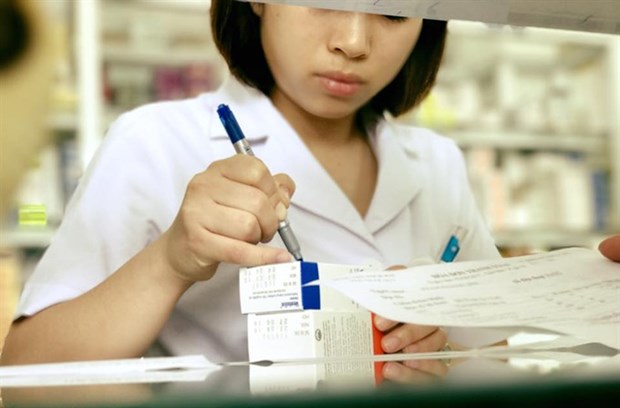
 A pharmacist reads a prescription at a drugstore in Hanoi’s Bach Mai Hospital (Photo: VNA)
Hanoi (VNA) – Half of all medicine used
in Vietnam is locally manufactured, however, it has been largely unused in
central hospitals, PhD Truong Quoc Cuong, Deputy Minister of Health, has said.
To increase the rate of use,
doctors could even be required to commit to prescribing domestic products,
according to Cuong.
Speaking at a conference reviewing the campaign
‘Vietnamese People Use Vietnam’s medicines’ held recently, Cuong said the use
of increased during the four years of the
campaign.
Of all medicine used at provincial-level
hospitals, 35.4 percent of it was locally manufactured, an increase of 1.5
percent compared to before launching the campaign. At district-level hospitals,
the rate was nearly 70 percent, 8 percent moiré than previously.
As many as 520 out of 923 active ingredients
licensed for use in medicine can be made in Vietnam, and awareness of domestic
drugs has improved, reducing hospital fees for patients and growing the
pharmaceutical industry.
Pharmaceutical factories have invested in modern
machinery and high-quality human resources to produce antibiotic and vaccine
materials, bio-products and high-tech dosage forms. The quality of medicine has
improved at cheaper prices than imported medicine.
Currently, there are 163 pharmaceutical
factories at Pharmaceutical Inspection Cooperation Scheme – good
manufacturing practices standards, with modern production-lines to produce medicines
to international standard.
However, Cuong said, most domestic medicine was
made from simple active ingredients to treat simple diseases. As a result, it
is unpopular at central hospitals that treat seriously ill patients.
The rate of use of domestic medicine at central
hospitals has in fact decreased during the project, from 11.6 percent in 2013,
to 11.3 percent in 2014 and 10.02 percent in 2015.
The percentage was even lower in key hospitals
such as 3.1 percent at the Central Maternity Hospital, 3.3 percent at Cancer
Hospital, 3.9 percent at Bach Mai Hospital and 5.8 percent at Vietnam-Germany
Hospital.
Cuong said the low usage rate at these hospitals
was down to two factors: doctor’s prescriptions and patients preferring
imported drugs.
In addition, he said, leaders of central
hospitals told him that they wanted to prescribe Vietnamese-produced medicine,
but most patients were seriously ill with deadly diseases, requiring medicines
the Vietnamese pharmaceutical industry can’t produce.
Dr Tran Viet Tiep, director of Vietnam-Sweden Uong
Bi Hospital, said that to reach the goal of 45 percent of drugs used in his
hospital being locally manufactured, leaders of the hospital must convince
patients and their families of the drugs’ quality by building treatment
protocols, participating in consultations and inspecting doctor’s
prescriptions.
Most antibiotics, painkillers and intravenous
medicines prescribed at the hospital were locally-made, he said.
Tran Tuc Ma, general manager of Traphaco JSC,
said that most of his firm’s products were sold at drug stores as the company
found it hard to sell them at central hospitals.
The reason, he said, was that products were
classified by their biological ingredients, not in terms of quality. Meanwhile,
enterprises had to invest in their products to make them better, leading to
higher costs compared to other products.
To hit targets in the second phase of the
campaign, Cuong said apart from getting Vietnamese consumers’ to use domestic
products, businesses must make more efforts to advertise their medicine at
affordable prices, improving product design, and proving its quality to gain
the trust of doctors and patients.
The ministry will continue encouraging doctors
to prioritise bidding for and prescribing locally-made drugs.
The campaign ‘Vietnamese People Use Vietnam’s
medicines’ was launched by the ministry and took place between 2012 and 2015.
In the second phase of 2016-2020, the campaign targets that 30 percent of drugs
prescribed at central hospitals are , with the targeted rates
at provincial and district hospitals 50 and 75 percent respectively.-VNA
Source: VietnamPlus


