

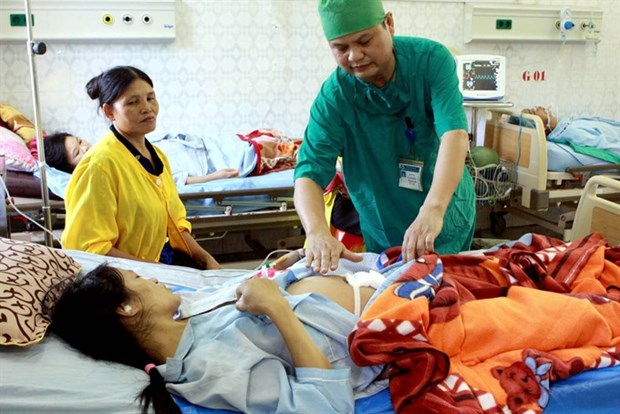
 A patient is treated at Ngoc Lac General Hospital in the central province of Thanh Hoa (Photo: VNA)
concern for and patients all over the world. Preventing
such infections is a critical aspect of improving , heard a recent
conference in Hanoi.
Addressing a conference on strengthening infection control in
healthcare facilities, Deputy Minister of Health Nguyen Viet Tien said hospital
infections are an especially significant burden for patients in under-developed
and developing countries. Hospital infections contribute to an increase in
fatalities, treatment time, usage of antibiotics and cost of treatment.
Statistics from the World Health Organisation (WHO) revealed
that the rate of hospital-acquired infections (HAIs) ranges between 3.5 percent
and 12 percent in developed countries. For European countries, the rate is 7.1
percent on average, causing about 7 billion EUR (8.6 billion USD) in losses
including the costs for treatment and hospital fees.
No specific data about HAIs in developing and under-developed
countries was available, but recent studies conducted by WHO showed that HAIs
occur more frequently at these countries due to limited resources.
Recognising the important role of hospital infection control
in providing successful treatment to patients, Tien said the health sector had
adopted measures to tighten infection control at health care facilities,
including the issuance of regulations and professional supervision on the issue.
As a result, most hospitals and health clinics started
mobilising sources for infection control activities, he said.
The infection control programme had been implemented at
healthcare facilities nationwide. Hand hygiene was undisputedly the single most
effective control measure for hospital-acquired infections.
However, he admitted that there were several challenges to
infection control in . The infection control system at healthcare
facilities remained incomplete.
Figures from the ministry showed that 16.2 percent of
hospitals nationwide failed to establish an infection control department and
26.3 percent failed to assign a head of the department to implement infection
control tasks.
Moreover, most health staff at the departments did not
receive training, and departments also faced staff shortages. Many hospitals
paid inadequate attention to investing in infection control practices as well
as equipment so the efficiency of the work was still limited.
Tien said poor infection control contributed to a measles
outbreak in April 2014, killing more than 110 children and hospitalising
thousands nationwide. It also played a role in the deaths of four pre-term and
low birth weight infants at Bac Ninh Hospital of Obstetrics and Pediatrics in
November 2017.
To improve the situation, Luong Ngoc Khue, Director of the
Ministry of Health’s Medical Examination and Treatment Management Department,
said infection control work should be tightened to minimise HAI contraction at
hospitals, ensuring the safety of health workers and patients, given the
prevalence of such diseases as Avian Influenza (H5N1, H1N1 and H7N9), Middle
East Respiratory Syndrome of Corona virus (MERS-CoV) and Ebola.
The health sector would be expected to organise training
courses for health staff on infection control and allocate funds for medical
equipment to implement infection control practices, he said.
Dissemination campaigns should be adopted to raise awareness
among patients and their relatives to improve infection control.-VNA
Source: VietnamPlus


