

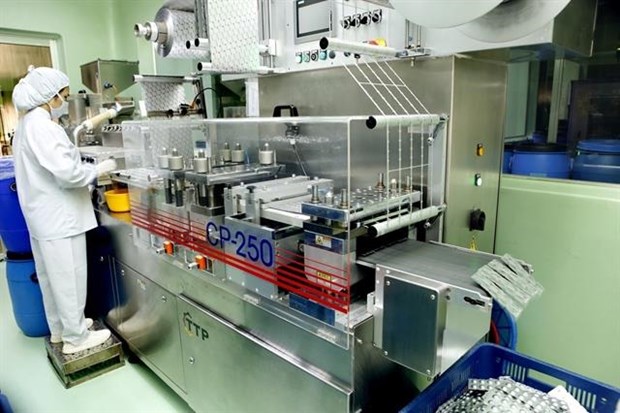
 Illustrative image (Source: VNA)
Hanoi (VNS/VNA) –
have met nearly half the demand of Vietnamese people in
, while the country has successfully
produced 12 out of 13 types of used nationwide.
These were some of the positive signs for the Vietnamese pharmaceutical
industry announced at a meeting held late last week to review the results of
the health ministry’s ‘Vietnamese people prioritise Vietnam-made
pharmaceuticals’ programme, which aims at reducing reliance on foreign drugs
and boosting domestic production.
Deputy Minister of Health Truong Quoc Cuong said in the last 10 years, there
has been a marked change of mindset among consumers, businesses and health
officials, with domestically-produced medications increasingly appreciated for
their quality and more affordable prices compared to foreign counterparts.
According to the Ministry of Health’s report, Vietnam currently has four
vaccine producers, with a capacity of 30 million doses for the entire country.
There are 198 pharmaceutical manufacturers that have obtained World Health
Organisation (WHO) Good Manufacturing Practice (GMP) certification, while 11
plants have been built and invested under the stringent standards found in many
advanced countries like the US, Japan or the European Union (EU).
As many as 652 medication products produced in Vietnam has been recognised as
possessing the same pharmaceutical properties of generic and designer drugs,
the report said.
In 2018, Vietnamese medications accounted for 65.53 percent of total medication
use in provincial-level and district-level hospitals, with half of the
provinces and cities in the country recording more than 50 percent of
Vietnamese drugs used.
The south-central province of Phu Yen, with 87 percent in 2018, leads the
country in terms of using domestically-made medicines, followed by Quang Binh,
Tuyen Quang, Kon Tum and Thua Thien-Hue with reported ratios of between 70-76
percent.
For many central-level hospitals in major cities of Ho Chi Minh City or Hanoi
however, the story is a little different.
While the general trend looks positive with incremental increases year-on-year
from 2015, hospitals directly under the health ministry’s management – also
usually the largest and most reputable in the country like Bach Mai,
Vietnam-Germany Hospital or the National Hospital of Obstetrics and Gynaecology
– still reported an average rate of below 10 percent of domestic drugs used, in
terms of monetary value, according to health ministry.
Explaining the low rate, Cuong said that these hospitals are considered the
‘highest level’ hospitals, receiving both patients from the major city they are
based in and from other provinces or patients which local hospitals are not
capable of treating, so the drugs used here are highly specialised – for
example, those for heart diseases, cancer drugs, anti-rejection medicines –
that domestic companies have not been able to make.
However, he noted that there remains a significant portion of Vietnamese – in
the general public and among health officials themselves – who are not totally
convinced of Vietnam-made drugs, especially generic ones.
Given the Government’s policy to encourage State hospitals’ financial
autonomies, the competition for consumers’ satisfaction might lead to
hospitals’ catering to Vietnamese people’s favouritism towards foreign-made
medications, Cuong said.
In order to change more people’s mindset, Cuong said that the health sector
would need to seriously step up its efforts in information campaigns across
various formats – including talk shows or radio and television programmes,
scientific conferences, and advertisements – to advocate the use of
domestically-produced drugs to a wider population.
The Ministry of Health has also recently launched the second edition of the
‘Vietnam Pharmaceutical Star’ programme to select the best, affordable medical
products to promote.
It is also considering putting the ratio of Vietnam-made drug use as one of the
criteria in the annual assessment of hospitals’ quality, as well as tightening
the management over pharmacists’ prescriptions of needlessly expensive
foreign-made products while Vietnamese alternatives are available.-VNS/VNA
Source: VietnamPlus


