

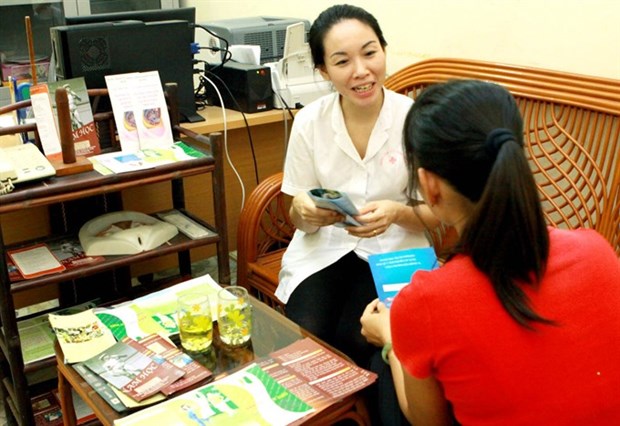
 Health staff give reproductive consultancy to a young woman at Hoan Kiem District’s Health Centre. (Photo: VNA)
HCM City (VNA) – Many young
Vietnamese couples seem to deliberately avoid pre-marital for
fear that these will find and ruin their budding marriages, a
survey found.
Dr Bui Duy Luat from the Department of
Kidney Surgery and Transplant under People Hospital 115, said he and his
colleagues were quite surprised to learn that of 400 young couples surveyed,
only 2 percent were willing to undergo premarital health tests for genetic and
infectious diseases.
The survey is not a comprehensive
statistical research given its small scale and the fact that it was conducted
during a talk on reproductive health held at the hospital, but the results are
quite alarming, he said.
According to the survey, 85 percent of the
participants said they had never even heard of premarital health examinations,
while 10 percent said they had but don’t know what these entail.
Luat attributed the lack of awareness of
such testing to the fact that authorities have not explained their importance
to young people. Some were concerned about the price of such tests, he added.
Another reason could be embarrassment.
According to a report released three years ago by the Maternal and Child Health
Department, a third of Vietnamese below 18 thought using a condom was
“inappropriate” behaviour, and 16 percent said condoms were for
prostitutes and adulterers only. That attitude might also pertain to the issue
of premarital health examinations.
But Luat also revealed that during the
talk, 70 percent said youngsters are worried that the diseases discovered would
ruin their marriage plans. A partner who brings up the issue of check-ups will
likely be misunderstood as lacking trust in the other, undermining the
relationship.
According to Dr Vuong Thi Ngoc Lan from the
Department of Gynecology at HCM City Medical University, couples who are fully
in the know about each other’s health before tying the knot will be more
prepared, psychologically and physically, for long-term plans.
For example, couples with detected
reproductive health issues will be able to take measures to increase their
chances of pregnancy.
Furthermore, even if one or both partners
are found to have certain conditions, these can be remedied. For example, if
semen analysis shows some abnormalities, it does not necessarily mean he is
completely infertile. “Most conditions are amenable to early diagnosis and
treatment,” Lan said.
Luat added that if health problems were
detected, experts would be readily available at medical centres to provide
counseling and treatment.
According to Luat, husbands and wives-to-be
registering for premarital checkups will be provided with diagnoses, treatments
and preventive measures for a range of conditions.
Conditions related to potential infertility
are part of the testing for bride and groom, and disease common to both sexes
are also tested, such as sexually transmitted diseases (STDs), tuberculosis,
hepatitis type B and type C. Risks of rubella, tetanus, chickenpox, blood
disease and birth defects, among others, for the babies born to these couples
will also be assessed and appropriate solutions are put forward.
Ho Ky Thu Nguyet of Tu Du Hospital said the
ideal time to get checkups is three to six months prior to marriage – “enough
time for the treatment of average conditions.”-VNA
Source: VietnamPlus


