

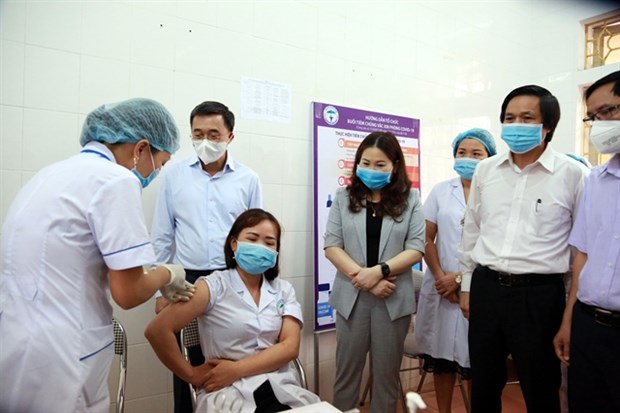
 Deputy Minister of Health Tran Van Thuan (standing, centre) and other experts from the Ministry of Health inspect in the Yen Binh District Medical Station, the northern province of Yen Bai. (Photo: VNA)
changes to procedures for the diagnosis, treatment and hospital discharge for
COVID-19 patients and called on hospitals to ensure they have sufficient oxygen
reserves.
At
an online conference on COVID-19 prevention and vaccination safety on April 28
morning, Associate Professor Luong Ngoc Khue, Director of the Medical Service
Administration under the MoH, said in the context of the spread of
COVID-19 in the world, the risk of pandemic infiltration into Vietnam was very
great.
Lockdowns
have been imposed in neighbouring countries like Laos and Cambodia, while
the virus is also spreading rapidly in regional nations like Indonesia and
the Philippines.
After
more than a year since it first broke out, the virus has
continuously changed, creating many different variants, making the virus more
infectious and difficult to control.
Virus
studies are becoming clearer, so Vietnam has rebuilt the treatment regimen for
SARS-CoV-2. This is the fifth update since March 2020.
In
the new regimen, the MoH classifies five clinical levels, from
asymptomatic, mild, moderate, severe to critical. If the patient has signs of
pneumonia they are classified as moderate.
Nguyen
Van Kinh, Chairman of the Vietnam Society of Infectious Diseases, said in
the fifth regimen, treatment must be one step ahead to prevent patients
from becoming critically ill, so close monitoring of patients is a top
priority.
To
reduce the incidence of serious illness, the MoH recommends as soon as the
patient’s blood oxygen level falls below 92 percent, consideration should be
given to appointing high-flow oxygenation through the nasal passages early or
non-invasive mechanical ventilation.
“India
had a lot of fatalities because there were no oxygen reserves, people with
serious illness had no oxygen and drowned on land. Therefore, medical
facilities must pay attention to oxygen reserves,” Kinh said.
To
be discharged, previous regimens required patients to have three consecutive
negative tests, each at least 24 hours apart. In the latest regimen, the MoH
changed the regulations.
Now,
patients are eligible for discharge from the hospital after at least 14 days of
treatment and with two negative tests, each 48-72 hours apart and the last
sample must be taken no more than 24 hours from the time of discharge./.
Source: VietnamPlus


