

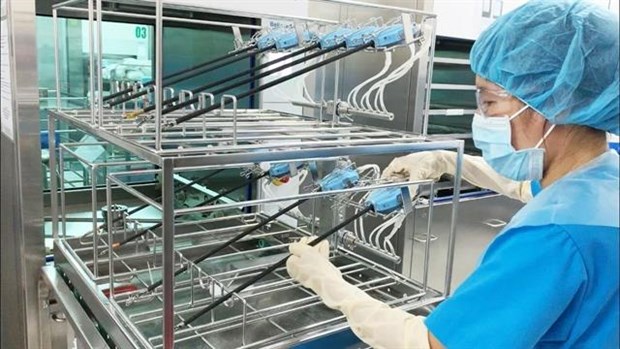
 A medical worker disinfects endoscopic instruments at Binh Dan Hospital in HCM City. (Photo: VNA)
Hanoi (VNS/VNA) – Hospital infections were becoming a common problem
that required more focus from the , Minister of Health Nguyen
Thi Kim Tien said.
Tien was speaking at a conference on September 30 about
efforts to control infections at healthcare facilities, especially in emergency
departments.
Hospital infections were one of the main threats to patient
safety, and had contributed to an increase in fatalities, treatment times, the
use of antibiotics and costs, she said.
They also caused overloading and reduced the quality and
reputations of hospitals. Some complications caused by hospital infections were
worse than the original problems that patients were admitted with.
In order to control these infections, the Ministry of Health
has taken measures to tighten control at healthcare facilities, including
issuing regulations and providing professional supervision.
According to Tien, some controls had already been put in
place, including supervision of hand hygiene and infection controls to improve
hospital sanitation and proactively prevent epidemics. However, she
admitted it was still a serious problem.
Speaking at the conference, Dr Luong Ngoc Khue, director of
the ministry’s Medical Examination and Treatment Management Department, said
the results of a survey conducted at 558 hospitals this year showed that 53.9 percent
of instruments in anesthesia departments were not being disinfected properly,
31.2 percent of facilities did not have microbiological monitoring systems.
Meanwhile, 56.1 percent of instruments in emergency
departments were not being disinfected; 21 percent of hospitals did not have
infection control departments; and about 22.6 percent of sanitation staff had
not received training on infection control.
Assessing this situation, the minister said that first of
all, some heads of health facilities were not fully aware of the role and
importance of infection control.
Moreover, most health staff did not receive training and some
departments faced staff shortages.
Hospitals did not have policies to attract and encourage
dedicated and professional people to work in infection control, Tien added.
Some hospitals were unable to provide comprehensive care due
to a lack of manpower, so it was down to family members to care for patients,
which also led to more infections, according to the minister.
To deal with such situation, Tien has instructed leaders of
healthcare facilities to commit to properly and fully implement legal
regulations and professional guidance on infection control issued by the
Ministry of Health.
Hospitals needed to arrange skilled personnel, upgrade
infrastructure and provide the necessary equipment to implement infection
control.
At the same time, health facilities needed to enhance checks
and supervision of hospital infections, and monitor compliance with infection
control practices among health workers, students, patients and family members.
Vietnam has established an infection surveillance system at
six hospitals. The ministry plans to pilot the system at 12 other facilities
and transfer technology to supervise at a further 30
hospitals./.
Source: VietnamPlus


