

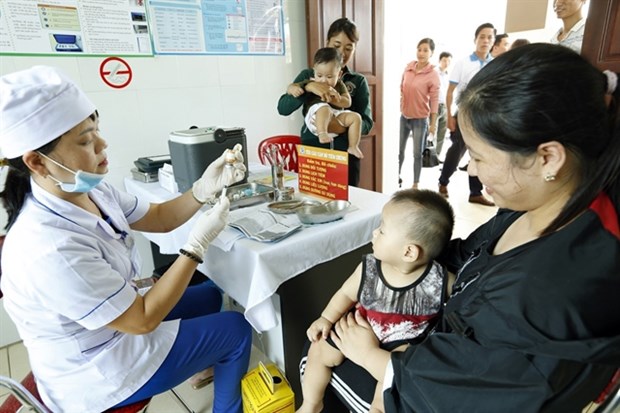
 A medical worker at Tuong Son commune Health Centre in the central province of Ha Tinh’s Thach Ha administers vaccinations to local children. (Source: VNA)
Hanoi (VNA) – and control is the main duty of the
health sector this year, thus the sector will actively conduct preventive
measures and provide vaccinations in high-risk areas.
Minister of Health made the statement in a nationwide
online conference on June 11.
The conference, connecting nearly 700 districts and towns in 63 provinces and
cities, aimed to implement plans covering diseases prevention and control and
safe vaccinations. It also updated professional guidance for district-level
s.
Speaking at the conference, Tien said vaccinations were one of the most
important measures to prevent dangerous infectious diseases.
Thanks to vaccination programmes over the past 30 years, many dangerous
infectious diseases had been eliminated.
Vietnam successfully eliminated polio in 2000 and tetanus from birth in 2005.
The results had been maintained until now.
Other infectious diseases such as measles, diphtheria and whooping cough caused
epidemics many years ago. Now they have been brought under control thanks to
regular vaccinations. Vietnam is striving to eliminate malaria, measles, rabies
and control rubella, said Tien.
Experts from the Ministry of Health (MoH) said new dangerous diseases from
other countries could enter Vietnam, and domestic diseases such as
hand-foot-mouth, measles and dengue fever could worsen due to climate change,
urbanisation, population density and emigration.
According to the experts disease prevention faces challenges because the
country does not have specialised medicines and vaccines for measles and
hand-foot-mouth disease.
Moreover, citizens’ awareness of disease prevention is not high enough. Some
groups of residents do not collaborate with local authorities and the health
sector in preventing the spread of disease, and do not actively implement
measures to ensure personal and environmental hygiene. Some residents refused
to give their children vaccinations.
Minister Tien said the Government issued decrees on vaccinations whereas the
MoH promulgated guidance circulars. These provided important legal foundations
creating good conditions for vaccination work.
During the conference, experts from the National Hospital for Tropical
Diseases, the National Paediatrics Hospital, the National Institute of Hygiene
and Epidemiology (NIHE) and other hospitals provided information on supervising,
treating and preventing several dangerous diseases such as dengue fever and
hand-foot-mouth. They updated attendees on new treatments and emergency aid for
patients suffering side-effects after receiving a vaccination.
Associate professor Tran Nhu Duong, deputy director of the NIHE, said for
infectious diseases, prevention should be the focus.
Local authorities should set up preventive plans based on their climate and
geographic conditions, and prepare enough medicines.
Grassroots-level medical centres could classify patients – who should be
hospitalised and who can be treated as outpatients – to reduce side effects and
fatalities, he said. — VNA
Source: VietnamPlus


