

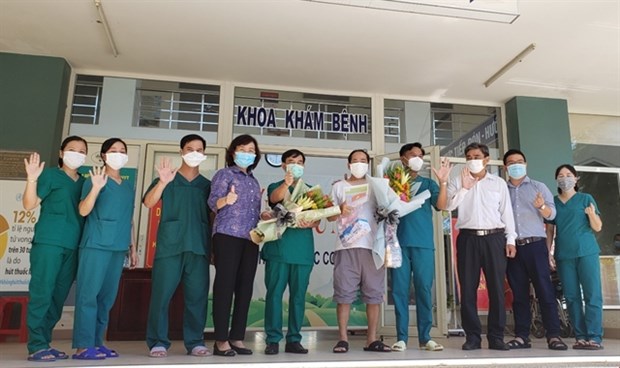
 Illustrative image (Photo: VNA)
 isolate, zone and control COVID-19 had played a decisive role in Vietnam’s
successful battle against the pandemic, experts have said.
“This has been an important strategy and contributed to the success of
disease prevention and control,” said Associate Professor Tran Nhu Duong, deputy head of the National
Institute of Hygiene and Epidemic, adding that the strategy had been
consistently applied since the start of the pandemic.
“When a COVID-19 case is detected in the community, the first thing to do right
away is to track all the people who have had contact with the patient and
quarantine them.
“Those who have had close contact with the patient, known as F1, are people at
high risk of being infected and can become a source of infection in the
community,” he said at a recent national teleconference to review the fight against the pandemic.
Tracing F1s as soon as a case is detected is a key part of disease containment
because there is a very small window in which to track and quarantine contacts
before they become infectious.
The incubation period between contact with the virus and start of symptoms
might be just 1-2 days or up to 14 days. Therefore, it was critical to trace
and locate contacts as soon as possible before they could potentially infect
others, Duong said.
He also said that the identification of suspected cases should be based on
epidemiological risk of infection.
Experience during the battle against COVID-19 in Da Nang showed that many
patients had travelled to different places, mainly Ho Chi Minh City, Quang Ngai and Quang Nam. Competent agencies collaborated with those
localities to track F1s.
“That approach has made tracing speedy and comprehensive. Without collaboration
with other COVID-19 response teams, it would take a team a few days or even
weeks to complete F1 tracing,” Duong said.
He said it was essential to be proactive and quickly make use of the
“golden time” after a case is detected to take samples for testing
and quarantine suspected cases to reduce the spread of the disease.
“All F1 cases must be isolated at centralised quarantined centres and not at
home because any negligence from them could leave a loophole in the disease
prevention system”, Duong said.
He cited Da Nang as a typical example.
The city’s authorities mobilised resources to quarantine 11,621 F1 cases, and
121 positive cases were detected among them.
Regarding the city’s zoning strategy, every day epidemiological groups from the
Government and locality analysed epidemiological data, and pointed out
complicated epidemic outbreaks. Then they advised local authorities to promptly
zone off certain areas.
The city identified more than 60 hotspots and zoned them off during the
one-month battle with the pandemic.
This strategy was flexible, easy to implement and helped to prevent the
pandemic while ensuring social security, Duong said.
Sharing experience on disease prevention and control, Ngo Thi Kim Yen, Director of Da Nang’s
Health Department, said when the first community transmission cases of
coronavirus were confirmed, the city mobilised all its forces to assess the
threat and implemented measures to deal with the disease.
On July 26, Da Nang Hospital was placed under lockdown and soon after that two
adjacent hospitals were closed.
Two days later, the city decided to impose to stop the spread
of the virus.
Thanks to the adoption of drastic measures, the disease was quickly controlled,
she said.
No community infections had been detected in the city for the past 38 days, Yen said, adding that the city
had applied the strategy of “prevent, detect, isolate, zone and control”.
The strategy also proved to be effective in HCM City.
Nguyen Tan Binh, Director of HCM City’s Health
Department, said with the direction of the political system and a joint
consensus among local residents, the disease was basically under control.
The city has recorded no community cases for 63 days.
Binh attributed the
result to the implementation of anti-disease plans, especially closely
monitoring people coming from other countries, territories, cities and
provinces.
One of the main factors contributing to Vietnam’s success in the fight against
COVID-19 was the mobilisation of the community, Duong said.
In the spirit of “fighting the pandemic like fighting the enemy”,
thousands of COVID-19 response teams were set up across the country.
Da Nang has 2,200 teams while Quang Nam has 5,500, and Quang Ngai and Quang Tri
have 2,300 and 4,434, respectively.
These teams were tasked with supervising and disseminating information on
disease prevention and control for each household. They acted as a bridge
connecting the Government, the health sector and the people.
“ response teams within the community were part of the creative and
unique response Vietnam adopted in the fight against the pandemic that few
places in the world could replicate. This is the most vivid demonstration of
people-based prevention, mobilising the entire population to stop the pandemic,
” Duong said./.
Source: VietnamPlus


