

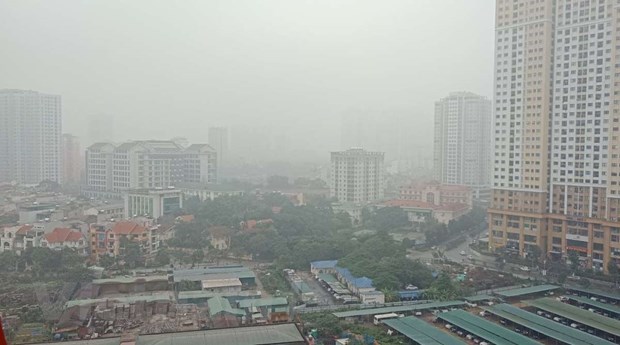
 Smog covers downtown Hanoi on February 11 (Photo: VNA)
Hanoi (VNA) – A discussion in Hanoi on February
25 called for smarter energy choices, given the impacts of coal power
generation on and air pollution’s influence on human health.
At the event, held on the occasion of the air
quality awareness week, said
coal power affects not only the environment but also people’s livelihoods and
social order around the plants, noting that the surrounding areas of coal-fired
power plants are impacted the most.
Statistics from the Green Innovation and
Development Centre (GreenID) show that emissions in the life cycle of a 1,200MW
coal-fired power plant include about 17 tonnes of lead, 1.66 tonnes of mercury,
117,818 tonnes of NO2, 139,636 tonnes of SO2, and 26,182 tonnes of dust. The
most dangerous is particulate matter that is less than 2.5 micrometers in
diameter (PM2.5), equivalent to only one-thirtieth of a human hair.
GreenID Director Nguy Thi Khanh said a survey of
residents near the Duyen Hai, Vung Ang and Hai Phong thermal power plants shows
that has seriously affected their health.
Giving further details about air pollution’s
influence on public health, Nguyen Thi Trang Nhung, a researcher at the Hanoi
University of Public Health, said the research team focused on children’s
health and collected data from the National Cancer Hospital and air monitoring
stations from 2008 to 2014.
Results showed that most pollutants caused
respiratory diseases in children; the possibility of disease contraction in
summer is higher than in winter; the older children are, the greater they are
affected by air pollution; and boys are more vulnerable to than
girls.
For people aged 16 and above, the team studied
hospitalised cardiovascular cases in Hanoi and Quang Ninh and Phu Tho
provinces, finding that PM1 and PM2.5 are linked with cardiovascular and
chronic obstructive pulmonary diseases and lead to asthma and strokes in people
over 64 years old.
However, the studies were limited since they did
not assess long-term impacts and the number of air monitoring stations remained
low, Nhung noted.
At the discussion, Khanh recommended that relevant
ministries and sectors issue policies on air environment protection such as
aligning domestic emission standards with international norms, prioritising
renewable energy development, and promoting the use of public transport and
electric vehicles.
Representatives from other non-governmental
organisations urged the reduction of coal and fossil fuel power, the
development of renewable energy, and efficient energy use.
They also called on Vietnam to be prudent in its
electricity sector development strategy until 2030, or the country could face
consequences in terms of the environment and human health./.
Source: VietnamPlus


