

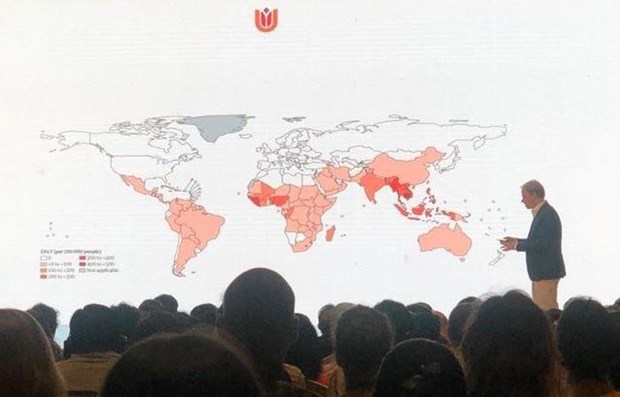
 At the symposium (Source: https://baomoi.com)
Hanoi (VNA) – The ninth
on opened in Hanoi on October 16, attracting over 100
scientists from 26 countries.
The three-day event is the largest of this kind, held every three years, focusing
on the most outstanding and about Whitmore, and sharing
experiences on early diagnosis and treatment techniques.
Clinical and , technologies for disease detection and diagnosis,
as well as antibiotics for disease treatment are being updated at the event.
Dr. Trinh Thanh Trung, Director of the Institute of Microbiology and Biotechnology of
Vietnam National
University, Hanoi, said the disease has been quickly spread
in the community and on the media, with false information, causing anxiety among
the community.
Whitmore (Melioidosis) is an infectious disease caused by a Gram-negative bacterium called Burkholderia pseudomallei. Most
people infected with this experience no symptoms. B. pseudomallei bacteria
are found in contaminated soil and water and spread to humans and animals
through direct contact with the contaminated source. However, there is no conclusive scientific evidence for human-to-human or
animal-to-human transmission in air.
Dr. Do Duy Cuong, Director of the Centre
for Tropical Diseases of Bach Mai
Hospital, said that this is a forgotten disease.
The disease recently were recorded
in not only in Vietnam, but also in many countries in the region such as
Cambodia, Thailand, Laos, Australia, India and many African countries, mainly
low- and middle-income countries, he added.
At the workshop, scientists also proposed rapid tests to diagnose the disease
as the current diagnosis takes from five to seven days or even more./.
Source: VietnamPlus


