

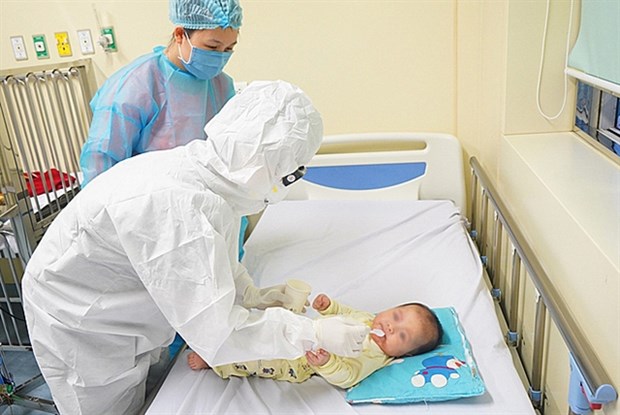
 A nurse (in white) takes care of a baby at the National Children’s Hospital in Hanoi during the COVID-19 outbreak (Photo: suckhoedoisong.vn)
Hanoi (VNS/VNA) – Vietnam needs to train more nurses starting now since
it has been forecast that, with its , there will be a shortage
of 40,000-50,000 of them by 2030.
Pham Duc Muc, president of the , told a meeting held
recently in Hanoi that the country now has around 140,000 nurses.
The State of the World’s Nursing 2020 says Vietnam has only 11.4 nurses per
10,000 people, less than half the global average.
Muc called for efforts to reach a rate of 25 by 2025.
It was also necessary to have a road map to ensure that all nurses reach at
least college level by 2025 as recommended by the , he
added.
Vietnam’s demography entered the ageing period in 2011.
It is forecast that the percentage of seniors will rise from the current 11 percent
of the population to 18 percent by 2030 and 26 percent in 2050, the Ministry of
Health has said.
The numbers mean there is a need to improve both the quality and quantity of
the nurses to better serve the needs of the population in the future.
There are around 196 universities, colleges and vocational schools to train
nurses, Tran Thuy Khanh Linh, head of the nursing department at the HCM
University of Medicine and Pharmacy, said.
Nguyen Minh Loi, deputy head of the ministry’s Science and Technology
Department, said the ministry is renewing all education and training programmes
so that it could achieve the target of getting all nurses to graduate at least
from college by 2025.
Working overtime
Assoc Prof Nguyen Thanh Binh, president of the Vietnam Union of Health Workers,
said the current doctor-to-nurse ratio in Vietnam is 1:1.4 whereas WHO’s
recommendation is 1:4.
The shortage of nurses means many have to work overtime often, according to Binh.
Medical staff, including , have had to work nearly four hours overtime on
average daily since the COVID-19 pandemic hit.
The long working hours are thought to severely affect their health.
But despite this they are not paid well enough.
A 2019 study by the Health Strategy and Policy Institute found that “87.4 percent
of healthcare workers thought their work required heavier responsibility and
carried greater pressure than other jobs.”
They also said their working environment was dangerous and carried the risk of
diseases.
Some 65 percent said their incomes did not fully cover their living expenses.
Some 59.7 percent said they were not satisfied with their salary while 24.8 percent
said the same about their allowances, the study said./.
Source: VietnamPlus


