

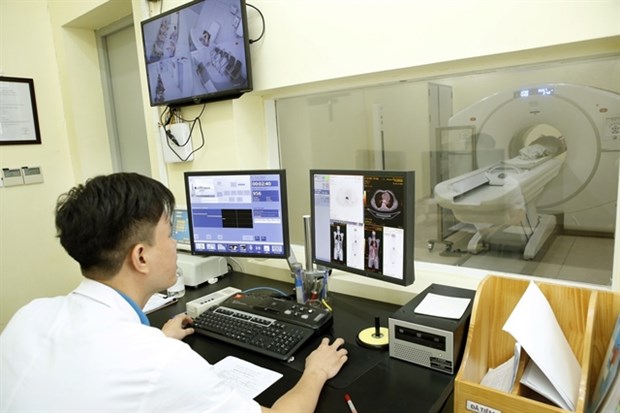
 Cancer screening at the National Cancer Hospital (Photo: VNA)
Hanoi (VNS/VNA) – Cancer is the second leading cause of death in Vietnam, accounting
for 17.9 percent and 19.9 percent of total deaths caused by diseases in the
country in 2010 and 2017, respectively.
Only
kill more in
the country annually.
The
statistics were revealed in the report ‘ in
Asia-Pacific: Progress towards universal cancer control’ by the Economist
Intelligence Unit (EIU) released early this month.
The
report looks at different responses to cancer in Asia-Pacific and the essential
elements needed to enhance preparedness in the region.
The
10 countries included in this study were chosen based on various factors
including size, income-level diversity and progress made towards universal
health coverage (UHC). They are Australia, China, India, Indonesia, Japan,
Malaysia, the Philippines, Thailand, the Republic of Korea (RoK) and Vietnam.
According
to the report, Vietnam ranks second from bottom in preparedness among
the countries with an overall score of 44.5 out of 100, just above the
Philippines whose score is 42.6.
The
regional average score is 66.5 while Australia, the RoK and Malaysia lead the
region with scores of 92.4, 83.4 and 80.3 respectively.
The
report also pointed out that in middle-income countries, the cancer mortality
rate ranges from 60 to 70 percent. Meanwhile, the percentage in high-income
countries is from 30 to 50 percent.
According
to the report, nearly 70 percent of cancer patients in Vietnam die, a figure
which raised public concern.
Director
of the Associate Prof. Dr. Le Van Quang told Suc khoe & Doi song (Health &
Life) newspaper that the EIU’s report took data from 2018 when Vietnam reported
165,000 new cancer cases and 115,000 deaths caused by cancer. The number of
deaths was not of new cancer cases but accumulated numbers from previous years.
“Cancer
mortality rate reported within one year cannot be as exact as those collected
in a period, for example, three or five years,” he said.
“To
evaluate any country’s ability in cancer treatment, it should be based on the
time patients survive after they receive diagnosis and treatment,” he said.
“It
is not true that 70 percent of cancer patients in Vietnam died within a year of
being diagnosed,” he said.
The
EIU’s report said the mortality rate of cancer patients within a year in
Southeast Asian countries including Vietnam is 29 percent.
In
Vietnam, the three most common cancers – lung cancer, liver cancer and
stomach cancer – usually develop fast with malignant tumours and are difficult
to treat.
Meanwhile,
in Australia, the three most common cancers are breast, prostate and colorectum
which usually develop slowly and can be treated well in Vietnam.
In
the RoK, the three most common cancers are thyroid cancer, stomach cancer and
colorectum cancer, Quang said, adding that Vietnam now can treat thyroid cancer
well.
He
emphasised that the types of cancer and causes of cancer affect
the mortality rate differently in different countries.
Currently,
Vietnam has similar equipment and medicine for cancer treatment as in
other countries.
However,
it still needed to improve and implement four major tasks in its cancer
prevention and control plans, Quang said.
The
four tasks are preventive measures, early screening, treatment and pain relief.
In
Vietnam, the cancer prevention and control programme is part of the programme
on non-communicable diseases prevention and control but funding for cancer is
modest.
In
addition, health insurance does not cover early cancer screening.
“In
the near future, if health insurance covers part of the cost for cancer
screening, especially for high-risk groups, more people can access the
screening,” he said.
“The
sooner the disease is detected, patients have more chance to be cleared from
the disease and medical costs are also reduced,” he said.
Quang
also called on people to have regular health check-ups for timely detection and
treatment./.
Source: VietnamPlus


