
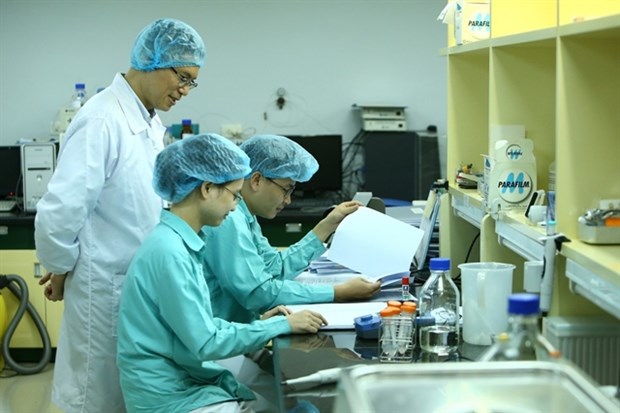
 COVID-19 vaccine development at Vaccine and Biological Production No.1 Company (Vabiotech) under the Ministry of Health (Photo: VNA)
Hanoi (VNS/VNA) – First phase of on a
could begin as early as this October.
The Institute of Vaccines and Medical Biologicals (IVAC) in
Nha Trang city, partnering with New York City-based Icahn School of Medicine
and the global health non-profit organisation PATH, expects to conduct testing
on small groups of volunteers in October-December this year.
Phase 2, comprising larger groups of people, and Phase 3, comprising
up to thousands, will be conducted at the beginning of 2021.
The institute plans to submit documents for approval to the
health ministry as early as April next year and claims to be capable of
producing 30 million doses a year.
By October 2021, the vaccine could be distributed to the
general population.
IVAC is researching an egg-based vaccine, making use of the
Newcastle disease virus (NDV) expressing the spike protein of SARS-CoV-2.
According to Duong Huu Thai, head of IVAC, the production of
its COVID-19 vaccine will be similar to the production of influenza vaccine.
The live NDV-Lasota-S virus – given to IVAC from its US
partner in May – is injected into a membrane of fertilised hen’s egg and
cultivated, then the propagated viruses are extracted from the membrane to be
inactivated while still maintain their physical properties.
The now inactivate virus, unable to cause disease, will still
trigger the body’s immune response that can target the coronavirus.
The vaccine candidate has shown initial positive results in
animals, Thái said, but it was too early to claim success.
“In research, no one can claim to be successful until [the
vaccine development] reaches the mass production stage,” he said.
Another firm, Vaccine and Biological Production No.1 Company
(Vabiotech) under the Ministry of Health, partnering with the UK-based
University of Bristol since February, said after trials on mice demonstrating
strong immune response to coronavirus, especially after the repeat shot, it
aims to conduct trials on small groups of people at the beginning of next year.
Vabiotech is developing its vaccine candidate using the
protein subunit method, using only part of the SARS-CoV-2 virus to stimulate
the immune system to release antibodies.
“To deal with the diverse mutations of SARS-CoV-2, we have
chosen the antigen that proved to have mutated the least,” said Do Tuan Dat,
Chairman of Vabiotech, explaining that the vaccine, if successful, would help
achieve immunity against various different strains of the virus.
The company said it is optimising production procedures for
large-scale production of the vaccine and could produce up to 100 million doses
a year.
Two other companies in Vietnam are researching a vaccine,
including the Centre for Immunisation Vaccines POLYVAC partnering with the
National Institute of Hygiene and Epidemiology, which is still waiting for
approval from the Ministry of Science and Technology for its research.
The last is Nanogen Biopharmaceutical company in HCM City,
using protein from the SARS-CoV-2 strain found in China’s Wuhan – where the
virus is thought to have first emerged – together with the mutated strain
D614G, the dominant strain rapidly spreading across the world, including the
ongoing outbreak in Vietnam.
The health ministry has asked the two companies to start
preparing for large-scale manufacturing in case their vaccines are approved.
Nguyen Thu Van, member of Scientific Council under the
Ministry of Health, said a Vietnamese-made COVID-19 vaccine could be obtained by
the end of 2021.
“If Vietnam can achieve that goal, that timeframe is already
expedited. Usually, it takes at least five to six years to produce a new
vaccine,” Van said.
Nguyen Ngo Quang, Vice Director of the Administration of
Science, Technology and Training under the Ministry of Health, said in a
meeting last month that even with an expedited timeline, “the vaccine’s
quality must still be ensured and the product must be able to prevent
coronavirus infection based on ethical principles in medical research”.
Vietnam health authorities have many times insisted that a
return to ‘normal’ can only be achieved with a COVID-19 vaccine, and the
country is aiming for self-reliance to make sure of sufficient distribution to
all its population of 95 million.
The local research developments come as Russia’s President
Vladimir Putin claimed Tuesday his country had created the world’s first
COVID-19 vaccine, an announcement that met with safety concerns over a lack of
testing.
Vabiotech’s Dat told Lao Dong (Labour) newspaper that they
have not considered buying the vaccine from Russia, as they need more data on
clinical trials, which Russian scientists have not publicly shared data on.
He also said that data for vaccine development in the UK and
the US is public and readily accessible, aiding Vietnam in the making of its own
vaccine./.
Source: VietnamPlus


