

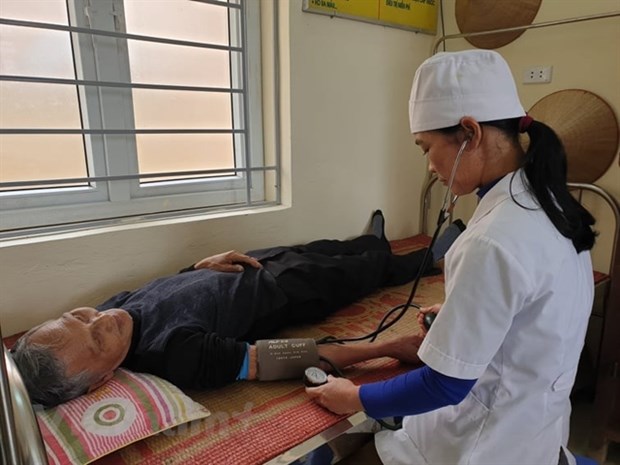
 An elderly patient receives a check-up at a commune health clinic. (Photo: VNA)
Hanoi (VNS/VNA) – Vietnam is one of the few countries with
a complete which had been widely expanded to villages
to provide to local people, Deputy Minister of Health Do
Xuan Tuyen has said.
The
model had gained interest from many countries around the world, he
said.
The
grassroots healthcare network in Vietnam had 1,400 hospitals, 180,000 beds
and more than 11,800 clinics.
The
training and development of human resources for
had also gained attention, with most having a doctor, obstetrician or
midwife.
In
2019, the health sector launched a training course to transfer technology
and improve the professional capacity of health workers.
As
part of the course, doctors and nurses from central hospitals in Hanoi and HCM
City are being rotated to support their colleagues at grassroots clinics.
Young doctors have been sent to work in mountainous and rural areas under the
ministry’s pilot Project 585 since 2013.
Under
the project, 354 young doctors in the fields of obstetrics, paediatrics,
imaging diagnosis, anesthesia, emergency resuscitation, infectiousness and
traditional medicine have been trained. Of them, 151 have volunteered to work
in 51 poor districts around the country and 195 are still
completing their training before moving to assigned areas.
Tuyen
said the ministry’s efforts to provide healthcare had contributed to
improving the quality of medical examinations and treatment at
a grassroots level, and people had easy access to local medical
services.
In
particular, the grassroots healthcare system had contributed in the
fight against the COVID-19 pandemic thanks to the infectious disease
supervision system, which had stopped the spread of the disease in the
community.
The
ministry has been piloting family medical plans at 26 clinics in eight
provinces and cities, while medical technology is being constantly updated
and transferred from central to local levels.
Notably,
care workers have made much progress after five years of reform.
The
2019 Provincial Governance and Public Administration Performance Index (PAPI)
showed that the citizen’s satisfaction index on public healthcare
had increased from 1.92 in 2017 to 1.96 in 2018.
Only
0.4 percent of patients in district public hospitals reported they had to bribe
medical staff to get better care. That figure in 2017 stood at 9 percent.
The
inpatient satisfaction index in 2018 reached 80.6 percent, backed up by a
survey conducted by Oxfam Vietnam.
To
further improve the quality and efficiency of grassroots healthcare services,
Tuyen said the ministry had launched a five-year project to
upgrade the system in 13 cities and provinces.
The
project has a total investment capital of more than 126 million USD. Of that, 80
million USD is from the World Bank, 25 million USD is from non-refundable
aid and the rest is from the Government.
Under
the project, 138 clinics will be built and 337 clinics will be upgraded and
provided with medical equipment. Health workers will be trained before working
in these clinics.
Acting
Minister of Health Nguyen Thanh Long said the ministry focuses on
grassroots healthcare in order to serve the people in a timely manner.
“The
ministry will connect provincial, district and commune health clinics
with remote medical examinations and treatment. A doctor at a central
hospital will support at least four health workers in provincial facilities,
four health workers in district facilities and two health workers in
communal clinics,” he said.
The
ministry also planned to launch a remote medical examination and treatment
project connecting 1,000 medical facilities to help people access the best healthcare
services, he said./.
Source: VietnamPlus


