

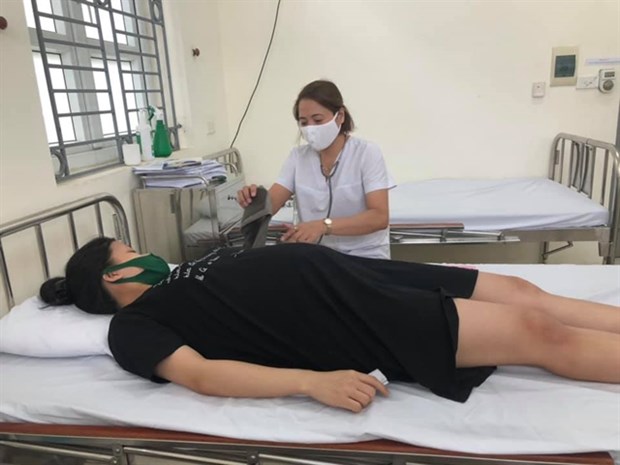
 A pregnant woman at the clinic of Tan Hoi commune of Hanoi’s suburban Dan Phuong district (Photo: VNA)
Hanoi (VNS/VNA) – Clinics in communes have improved their healthcare
services and facilities to attract more local people and reduce
patient overloads at city and province-level hospitals.
For
years had poor reputations and few patients, but that
image has changed.
The
clinic of Tan Hoi commune in Hanoi’s suburban district of Dan Phuong is an
example.
In
recent years, local people have been going to the commune clinic when they
have health problems instead of the city hospitals as before.
Every
day, the clinic receives people for vaccinations, pregnancy checks,
to pick up medicine or those hospitalised due to accidents, according to doctor
Tran Thi Mai Huong, head of the clinic.
As
one of the outstanding commune-level clinics of Hanoi, Tan Hoi Clinic has
contributed to improving the quality of primary healthcare for people in the
commune, attracting more and more patients and creating trust in local
medical examination and treatment.
“The
number of patients who have come to check their health and get medical
treatment in the clinic has increased year by year,” said Huong.
“Last
year, the clinic provided medical examinations for more than 10,000 people,
doubling the numbers in previous years,” the doctor said.
“So
far, we have given monthly health checks and medicine for 597 patients with
hypertension and 145 patients with diabetes. In the first eight months of this
year, the number of the two groups of patients remarkably increased from
previous years,” the doctor said.
“The
main reason for increasing trust of the people in the commune clinic was that
the qualifications of medical workers and quality of have been
improved, and people can now come to the nearest place for medical
examination and treatment, and the full cost of examination and treatment is
covered by health insurance,” she added.
Expanding
the medicine and medical techniques covered by health insurance has
also helped attract more patients to the clinic.
The
Tan Hoi Clinic has been approved for nearly 1,100 medical techniques and 140
kinds of medicines.
Similarly,
the clinic in Minh Chau commune of suburban Ba Vi district with nine doctors and
20 well-equipped departments has attracted more patients in recent years.
Doctor
Chau Le Thi Loc, the clinic’s head, said since applying the family medicine
model, local people had more trust in the clinic.
Every
month, the clinic received 400 patients, double the figure of previous
years, said Loc.
The
clinic can offer 80 percent of examination and treatment techniques of the
basic medical package service on the health insurance list.
According
to Hanoi’s Health Department, since last year, the city had launched 456
standardised clinics in communes, reaching 95.19 percent of the target.
The
commune-level health establishments are fully invested in terms of
infrastructure, medical equipment and human resources which has helped local
people access quality medical services and help localities carry out preventive
healthcare.
The
department’s statistics showed that the total number of patients at these
grassroots-level clinics was more than 900,000 for the first eight months this
year, equal to 248 patients per month per facility.
Medical
experts have said the grassroots healthcare system is the foundation of the
national health system and if the grassroots system is done well, it can
meet 70 per cent of common healthcare needs.
Commune
clinics are responsible for providing primary healthcare services including
preventive medicine, medical examination and treatment, reproductive
healthcare, supplying essential drugs, and community health management.
Vietnam
has set a target that by 2025, over 90 percent of the population will have
health management records, 95 percent of commune, ward and town health
establishments will carry out preventive medicine and provide treatment of some
non-infectious diseases such as hypertension and diabetes, and by 2030, more
than 95 percent of the population will have health management and 100 percent
of grassroots clinics will be able to treat some non-infectious diseases.
This
is a goal that requires considerable efforts, including the role of expanding
health insurance coverage at grassroots healthcare facilities.
Effective use of health insurance
According
to doctor Huong, the major difficulty for commune clinics at present is a lack
of human resources.
In
addition, examination and counselling for early detection of diseases for
people with risk factors have not been widely implemented because they are not
yet covered by , she said.
The
payment for health insurance is still difficult and new techniques are
only covered up to 70 percent.
“If
the issues were solved, the local people would be examined and treated in the
clinics which would help reduce the transfer to upper-level hospitals,” Huong
said.
To
improve the quality of grassroots healthcare, the Ministry of Health will step
by step reform the payment method, issue and update the basic health service
package in accordance with the health insurance fund and State budget.
Currently,
the ministry is surveying 26 commune clinics of eight provinces and
cities in the northern, central and southern regions to pilot a medical
programme.
Under
the programme, the clinics will work in a family medicine form that all local
people will have their health supervised and get medical examinations at least
once a year.
The
delivery of medicines to treat chronic diseases such as diabetes, hypertension,
HIV/AIDS, tuberculosis at the clinics is one of the priorities of the
ministry to reduce the patient overload for higher-level hospitals and cut
travel costs and increase treatment compliance of patients.
To
improve the treatment of grassroots-level healthcare establishments and
encourage people to buy health insurance, the ministry issued a circular
regulating the lists and rates of insurance payment for pharmaceutical
products, bio-products and radioactive drugs
Under
the circular, 61 new drugs were added to the list of insurance payment to meet
the treatment needs and suitable for the development of the pharmaceutical
industry
The
ministry has increased the rate of insurance payment for six new drugs to
facilitate patients with health insurance cards to increase access to medicines
at the clinics.
According
to experts, to strengthen healthcare services covered by health insurance
at commune clinics, the health sector must focus on reforming the healthcare
payment mechanism covered by health insurance.
The
payment reform should not regulate the percentage of health insurance funds
used at clinics but implement capitation payments, issue a basic health service
package at the communal level, strengthen management and treatment of chronic
diseases, especially for those diagnosed at higher levels, and comply with the
ministry’s treatment protocol.
In
terms of infrastructure facilities, clinics should be invested with housing and
equipment under the standardised model as well as develop common software to
manage information about clinics’ activities and people’s health records./.
Source: VietnamPlus


