

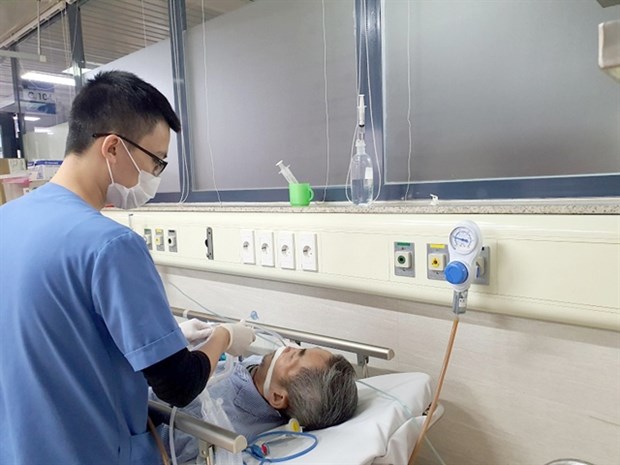
 An elderly man is treated at the . The cold snap has been blamed for an escalation in the number of senior citizens hospitalised (Photo: nhandan.com.vn)
Hanoi (VNS/VNA) – The cold weather which has hit the northern region
with temperatures of 8 to 10 Celsius degree has reportedly been accompanied by
a surge in the number of people suffering from strokes.
Dao Viet Phuong, from ’s Stroke Centre, said the centre has received 2,000 stroke
patients since it was established in November.
More people have recently also been taken to the National Geriatric
Hospital (NGH) and the 108 Military Hospital.
Nguyen Danh Cuong, deputy head of the Emergency and Stroke Department of
the NGH, said the cold snap was the reason for an escalation in the number of
senior citizens hospitalised for emergency treatment.
The hospital admitted 50-60 patients a day compared to 30-40 on normal
days. Most of them are serious cases with blood pressure problems, heart
diseases and strokes; some even need a ventilator, he said.
“As the organs of the elderly are ageing, they are more susceptible to
respiratory diseases such as sore throats or bronchitis than young people. A
sudden change in temperatures can lead to a higher risk of a stroke,” he
told Suc khoe va doi song (Health and
Life) newspaper.
Hospital admission rates for strokes have also reportedly increased in
medical centres in northern provinces like Hoa Binh, Quang Ninh and Lao Cai.
Ta Huy Kien from Hoa Binh General Hospital said each day the hospital
received 7-8 stroke patients during cold snaps.
The number of patients seeking treatment for the disease hit nearly 240 from
December 1 last year to January 10, he said, adding that strokes often occurred
in people aged from 50 years old with underlying health conditions including
diabetes and high blood pressure.
According to Phuong, the is a factor that heightens the risk of
.
When temperatures go down blood vessels in the skin constrict so the body
doesn’t waste a lot of heat, which can raise blood pressure. Many patients are
hospitalised with a paroxysmal 130/80 mm Hg blood pressure.
High blood pressure is the cause of 80 percent of strokes in Vietnam.
Scientists have discovered a reduction of every two mmHg in blood pressure
results in a 10 percent reduction in deaths from stroke.
If the blood pressure is maintained at the optimal level of 120/80 mmHg, it
will prevent stroke complications in most cases.
Long-term hypertension will increase atherosclerosis and formation of blood
clots which easily causing cerebral infarction. In addition, high blood
pressure also increases the pressure on brain arteries, causing blood vessels
to rupture, causing brain bleeding, Phuong said.
Cold weather also makes many people tend to eat more salty and more fatty foods
while reducing exercise.
“It is dangerous that when it is cold, patients with hypertension are too lazy
to take medicine or run out of medicine but they are afraid to go to see
the doctor again, making the blood pressure uncontrollable,” he said.
It is estimated an annual incidence of strokes in Vietnam at 200,000 and the
figure increases by about 2 percent every year. However, people don’t have
knowledge about the disease, measures to prevent it or first aid, said Phuong.
He said one of the most important criteria for reducing complications in
stroke patients was to go to the hospital early.
“As soon as one of your relatives has such symptoms as hemiplegia,
distorted mouth or slurred speech, you should immediately call an ambulance and
bring them to the nearest hospital.”
“We always want patients to arrive at the hospital within three hours from the
time their symptoms appear but it is extremely difficult. There are only a few
cases in Hanoi when this happens while the rest are mostly late.
“Many people are hospitalised after 2-3 days. At that time, treatment is
very difficult and the ability to recover is limited,” he said.
For patients with cerebral haemorrhage, if they come to the hospital early,
their blood pressure will be controlled, greatly reducing after-stroke risks,
according to Phuong.
The Ministry of Health has sent an urgent dispatch to departments of health in
cities and provinces in the northern and central regions ordering preventive
measures to protect people’s health in response to the cold snaps.
They were asked to guide people on how to keep warm outside and in closed
rooms.
Health facilities were also required to ensure there was enough medicine for
treatment and enhance control over diseases including blood pressure,
cardiovascular and respiratory diseases, especially in the elderly and
children.
The National Centre for Hydro-Meteorological Forecasting said that temperatures
in the north will continue dropping in the next few days.
Cold air hit the northern delta area on January 19 with the lowest temperature
of 9-12 degrees Celsius and 5-8 degrees Celsius in mountainous areas.
Meteorological experts have warned that snowfall is predicted to occur in the
high mountain areas of Lao Cai and Lai Chau provinces in the next few days./.
Source: VietnamPlus


