

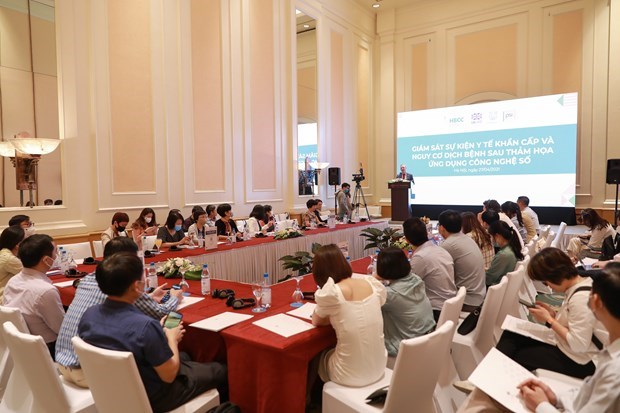
 UK Ambassador to Vietnam Gareth Ward speaks at the event (Photo: VNA)
 on April 28 highlighted the important role of the and digital
technology in and monitoring.
After global disease outbreaks in the past, 196
countries, including Vietnam, agreed to comply with the International Health
Regulations 2005 to develop the capacity of collecting and analysing health
information so as to make early warnings and response to public health events.
Event-based surveillance (EBS), one of two
methods for monitoring communicable diseases, aims to quickly detect any public
health events that run the risk of causing disease transmission and outbreaks
or affecting public health, and to issue a timely and appropriate response,
thus minimising any negative impact on the public.
EBS is conducted by collecting information from
three main sources: the community, healthcare establishments or testing labs,
and the media (press, social networks).
Nguyen Thi Huong, an official from the Ministry
of Health’s General Department of Preventive Medicine, pointed out the low participation
of private health establishments in public health surveillance and reporting, even
though the sector is potentially a major source of input information for EBS.
Since 2020, based on the success of involving
the private healthcare system in screening and reporting non-communicable
diseases, malaria, tuberculosis, and HIV, Population Services International
(PSI) Vietnam has applied chatbots, via which private healthcare facilities
report suspected COVID-19 cases and infectious diseases that may turn into
outbreaks.
The application has received financial support
from the UK Department for International Development, the Unilever group, and
the World Health Organisation in Vietnam.
PSI Vietnam has carried out a project on
engaging the private sector in public health emergency response in Hanoi and
the provinces of Bac Ninh, Thai Nguyen, Ha Nam, and Quang Binh. The project has
applied technological solutions to optimise efficiency and increase the
timeliness of the EBS system.
After six months, it has provided training on the
system to nearly 3,100 pharmacies and clinics. More than 81,900 cases with suspected
symptoms have been reported via the system, becoming a source of supplementary
data for the early detection and zoning of disease hotspots.
Underlining the importance of engaging the
private healthcare sector in EBS, UK Ambassador to Vietnam Gareth Ward said close
cooperation between the Government, international organisations, and private
healthcare establishments can help boost the application of scientific
initiatives so as to secure the public’s health and safety and sustainable
development./.
Source: VietnamPlus


