

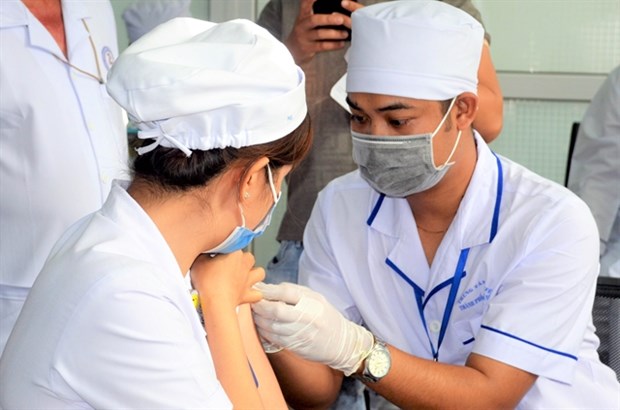
 Medical staff at Soc Trang General Hospital in the southern province of Soc Trang receive COVID-19 vaccines (Photo: VNA)
Hanoi (VNS/VNA) – The Vietnamese has recently issued
guidelines on protocols for diagnosis and treatment of rare brain/abdomen blood
clots in the setting of low levels of blood platelets occurring after
.
It
stressed that these incidents are serious, but a very rare and
unusual complication that seems to occur more among women younger than 60 years
old.
The
incidents that take place after administering COVID-19 vaccines by AstraZeneca
and Johnson & Johnson were documented by drug authorities and vaccine
safety monitoring agencies in many countries, the ministry noted.
The
clinical symptoms – including lasting serious headaches, seizures, breathing
difficulties and chest pains, abdominal pains, pain and oedema of the lower
extremities, but rarely bleeding or skin haemorrhage or internal bleeding –
show within four to 28 days after being administered the vaccine.
Imaging
diagnostics – such as ultrasound and pulse doppler – of sites with clinical
manifestations such as abdomen or the limbs can show thrombosis. X-raying and
computed tomography (CT) or magnetic resonance imaging (MRI) scans at suspected
sites such as in the brain, lung, or painful areas etc. can show signs of
thrombosis or bleeding.
The
Ministry of Health said that commune- and ward-level health stations and
district-level medical centres must monitor people who have received the
COVID-19 vaccines, and if the injected person shows any of clinical symptoms,
medical staff must perform “emergency measures” and transfer the
patient to the higher-level health facilities.
Health
centres are also told to conduct a platelet count, imaging and X-rays on
suspected patients to diagnose the underlying conditions, and contact experts
for those with abnormal symptoms.
Vaccinated
persons who suffer from severe headaches, localised neurological symptoms,
seizures, difficulty breathing, chest pain, life-threatening bleeding should
also be transferred to higher level.
Provincial-
and municipal-level health facilities need to conduct tests and treatment of
probable conditions that may be encountered in line with diagnosis and
treatment guidelines of the Ministry of Health. If the patient’s condition
progresses beyond the capacity of their diagnosis and treatment, it is
necessary to consult a specialist or to refer to the higher-level medical
facilities.
Central-level
hospitals are supposed to receive the patients with severe reactions to
vaccinations, and consult experts for treatment if necessary.
Minister of
Health Nguyen Thanh Long issued Decision No. 1888/QĐ-BYT on April 15 to
establish a steering committee for safe COVID-19 vaccination, which comprises
of senior officials from the ministry and leaders of the ministry’s related
departments along with Vietnam’s leading experts and scientists in diverse
fields from immunisation, infection, emergency resuscitation, intensive care,
to haematology, cardiology and neurology.
The steering committee
is tasked with guiding medical establishments in performing screening,
monitoring and handling of adverse events following COVID-19 vaccinations and
promptly assist localities in handling all situations safely.
Dao Xuan Co,
Chairman of the Vietnam National Association of Emergency, Intensive Care
Medicine and Clinical Toxicology, and Deputy Director of Bach Mai Hospital, the
largest first-tier public hospital in the northern region, said that
post-vaccination blood clot incidents could be handled just like any other
commonly occurred blood clot.
Co reassured
that the public could have “peace of mind” for receiving the COVID-19 vaccine
given the very small risk, and even if such an incident does happen, the
expertise of leading scientists would be available to intervene in a timely
manner.
However, given
the nature of the COVID-19 vaccine approved for emergency use, Vietnam has been
quite cautious in its vaccination drive.
“We do screening
and counselling before the administration of the vaccine,” Co
said.
“The
injected person is monitored at the vaccination site for at least 30 minutes,
then continues to be monitored at home for at least 24 hours and follow-up
observations for another three weeks after injection. Hospitals are always
ready to prevent severe reactions after injection.”
According to a
report of the National Expanded Programme on Immunisation released on April 27,
a record of 50,104 people were inoculated on April 26.
Nearly 260,000
people – mostly frontline workers and medical staff – in 42 provinces
and cities have been inoculated using AstraZeneca vaccines since the national
vaccination drive began on March 8.
No rare blood
clot incidents have been recorded so far, while the typical reactions
(tiredness, mild fever, muscle pains, etc.) were reported in about 30 percent
of the vaccinated, even lower than the advisory from the manufacturer or
European authorities’ reports.
The country
currently has nearly 1 million doses of AstraZeneca vaccine (combined
deliveries from the manufacturer and supplied via the COVAX Facility), along
with 1,000 doses of Sputnik V vaccine as gift from Russia./.
Source: VietnamPlus


