

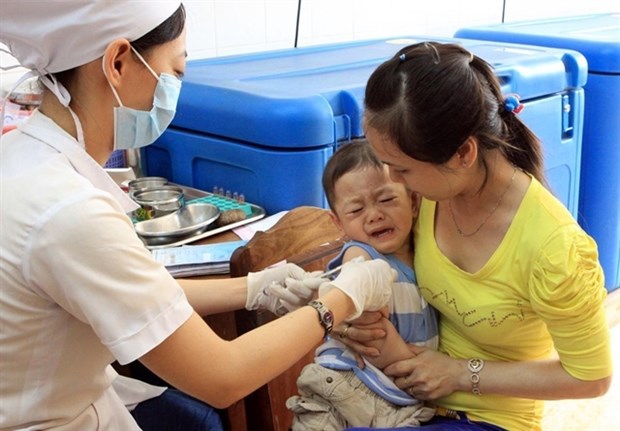
 A child is vaccinated in Binh Duong province. (Photo: VNA)
HCM City (VNS/VNA) – There are increasing concerns
the prolonged may soon lead to the resurgence of infectious
diseases in Vietnam.
This comes as the vaccination rate for the Expanded Programme
on Immunisation (EPI) fell short of the annual targets last year.
In 2022, only three out of 20 provinces and cities in the
southern region achieved the full vaccination rate for children under
one year old, and the overall vaccination rate for the region reached only
79.5% due to the vaccine shortage in the EPI.
According to Hoang Ngoc Mai, thanks to reserves, vaccines were
still adequately supplied in the early months of 2022. However, by mid-2022,
the supply was not quickly replenished, leading to a shortage of a number of
vaccines nationwide for diseases such as measles, DPT
(diphtheria-pertussis-tetanus), measles-rubella (MR) and polio
(bOPV).
To cope with the shortage, the Institute of Vaccines and Medical
Biologicals, the Centre for Research and Production of Vaccines and Medical
Biologicals sponsored 328,280 doses of DPT vaccine and 200,000 doses of measles
vaccine to the programme, helping to meet the demand for a month.
But shortage has recurred and persisted since then. Due to the
lack of vaccines, in 2022, most of the vaccination rates in the EPI did not
reach the annual target and had been lower than the 2021 rates.
In the southern region, 14 provinces had vaccination rates below
80%, such as Dong Nai, Tien Giang, Lam Dong, Tay Ninh, Can Tho, Soc Trang, An
Giang, Tra Vinh, Dong Thap, Binh Phuoc, Kien Giang, Ca Mau, Bac Lieu and Hau
Giang.
The catch-up vaccination rate in the southern region was also very
low. In 2022, only 16 out of 20 provinces implemented catch-up ,
with 338,026 doses administered.
In the first quarter of 2023, only 18 provinces and cities
conducted catch-up vaccinations, with 123,498 doses administered. This number
is very low compared to the number of children that are in need of catch-up
vaccination and does not significantly change the vaccination rate in the
region.
Risk of infectious disease outbreaks
Mai said that the low vaccination rate puts Vietnam at risk of
large-scale outbreaks of . She noted that the World Health
Organisation (WHO) has classified the risk of polio returning to Vietnam from
the lowest level to a medium-high level.
Duong Thi Hong, Deputy Director of the National Institute of
Hygiene and Epidemiology under the Ministry of Health, and Head of the National
Expanded Programme for Immunisation Office, said that currently, most provinces
have run out of the 5-in-1 DPT-VGB-Hib vaccine against diphtheria, whooping
cough, tetanus, hepatitis B, and haemophilus influenzae type
b (Hib).
Some vaccines are in very limited supply and only enough for use
until July 2023, such as DPT, tuberculosis (BCG), pertussis (DTaP), and
measles-rubella vaccines.
Meanwhile, the polio vaccine supply is sufficient until August
2023. The EPI has compiled all vaccine needs from localities and submitted them
to the Ministry of Health.
Hong said that the health ministry is making efforts to restore
the vaccine supply for the programme. The ministry will establish a common
price framework for imported 5-in-1 vaccines, and localities will quickly sign
contracts with manufacturers based on actual needs, after obtaining results of
procurement through bidding or price negotiation according to regulations,
quickly sign the contract to receive the vaccine. This method is similar to
what the Department of Health has done to buy some drugs.
“In June, the ministry will issue an official document
requesting the quantity of orders,” she said.
“Localities must have an accurate figure of the required
vaccine quantity to avoid situations of excess or shortage compared to the
demand.”
HCM City is one of the localities affected by the disruption of
vaccine supply in the EPI due to a large number of children in the vaccination
age group.
According to the city’s Department of Health, the shortage of
vaccines for EPI started in May 2022 and has continued until now.
Despite sending multiple recommendation letters to the health
ministry, the quantity of supplied vaccines has not been sufficient to meet the
vaccination needs of young children in the area.
According to the projection of the Department of Health, from now
until June 2024, HCM City needs approximately 1,553,000 doses of various
vaccines in the EPI.
The EPI is providing immunisation to 10 vaccine-preventable
diseases in Vietnam.
It is estimated that EPI has saved 42,000 lives and prevented more
than 6.7 million childhood diseases like polio, tetanus, diphtheria, measles
and pertussis with high vaccine coverage.
Cubersome procedures slow down supply
Nguyen Dang Hien, Director of the Centre for Research and
Production of Vaccines and Medical Biologicals, which is currently responsible
for producing and supplying four types of vaccines for the EPI (including bOPV,
measles, and measles-rubella), said that in previous years, there was no
shortage of vaccines because the centre would usually produce a certain surplus
quantity of vaccines for future years, even without specific plans or orders.
However, in the past two years, due to changes from the Ministry
of Health, the centre no longer produces a surplus but manufactures vaccines
based on specific orders.
Recently, the centre received a document from the health ministry
regarding the proposal of pricing plans, which will be submitted to the
ministry for approval.
Based on the approved prices by the health ministry, the EPI will
sign a joint contract to purchase vaccines, and provinces and cities will place
specific orders with the manufacturers accordingly.
However, in order to accomplish this, the manufacturer needs
an accurate quantity to determine the vaccine price and forecast the raw
materials for production planning.
In addition to the quantity, localities need to provide the
manufacturer with the delivery schedule, such as how many times a year they
will receive shipments and when they will receive them, so that the company can
have appropriate production plans.
“The vaccine supply is not something that can be instantly
fulfilled, we need to have a plan to prepare for purchasing raw materials. Only
with accurate forecasting and ordering can we ensure the domestic vaccine
supply,” said Hien.
Agreeing with this, Tran Thanh Hieu, Deputy Director of the state-owned
Company for Vaccine and Biological Production No.1 (VABIOTECH),
said that the Ministry of Health and the EPI need to be proactive in placing
orders so that companies can be proactive in production and supply.
Hieu said, like the Centre for Research and Production of Vaccines
and Medical Biologicals, in previous years, VABIOTECH had produced a certain
quantity of vaccines for stockpiling, ready to supply when needed. However, due
to various objective conditions, the unit is currently unable to produce a
large quantity.
Therefore, if the health ministry and localities have plans and
place orders early, the enterprise can respond in a timely manner.
“To ensure a steady and sustainable supply, it is necessary to
have a long-term plan, at least two years, so that the entire programme,
manufacturers, and users can be proactive,” said Duong Huu Thai, Director
of the Institute of Vaccines and Medical Biologicals (IVAC), which has provided
four types of vaccines for the EPI./.
Source: VietnamPlus


