

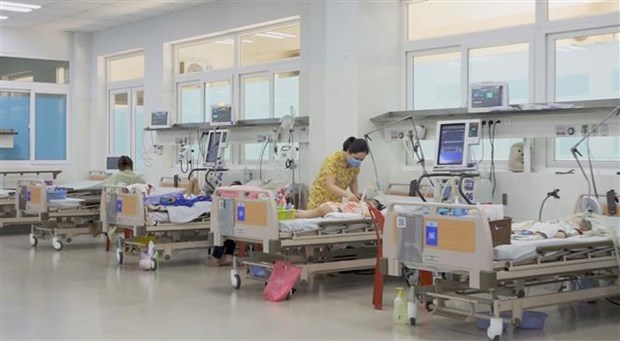
 The Ministry of Health has proposed that five will be upgraded to modern hospitals with healthcare services in line with international standards. (Photo: VNA)
Hanoi (VNA) – Five special-grade hospitals in Vietnam will
be upgraded to modern hospitals with meeting international
standards under a proposal by the (MoH).
The
proposal is included in the national health system development plan for the
2021-2030 period, with a vision towards 2050, aiming to reduce the number of
Vietnamese people going abroad for treatment, as well as to attract foreigners
to come to Vietnam for medical examination and treatment.
According
to Associate Professor, Dr Luong Ngoc Khue, Director of the ministry’s Medical
Examination and Treatment Department, Vietnamese doctors have succeeded in
mastering many high-level treatment techniques such as dental procedures, in
vitro fertilisation (IVF), stroke treatment, liver, kidney, and heart
transplantations, joint treatment, endoscopic surgery, eye surgery, and
diagnostic techniques.
“The development of medical techniques has attracted many overseas
Vietnamese to come back to the country for treatment. Several major hospitals
in Vietnam have recently attracted a significant number of foreign patients for
medical check-ups and treatment,” he said.
He said
one of the strengths of the domestic healthcare system is its lower costs
compared to other countries while maintaining a comparable quality.
The MoH
also proposed upgrading and investing in 20 provincial general and specialised
hospitals to be able to receive patients from the entire region, especially in
areas with difficulties in accessing central-level hospitals and densely
populated areas.
In the
development plan, the MoH also outlined the direction for the development of
non-public healthcare sectors, focusing on providing high-quality technical
services, on-demand medical examinations and treatment, encouraging
public-private partnerships, and private investments.
It aims
to expand the bed capacity of private hospitals to reach 10% of the total
national bed capacity by 2025, 15% by 2030, and 25% by 2050. By 2025,
the country is expected to provide 35 hospital beds, 15 doctors, 3.4
university-trained pharmacists, and 25 nurses per 10,000 residents.
These
numbers are expected to increase to 35 hospital beds, 19 doctors, four
university-trained pharmacists, and 33 nurses per 10,000 people by 2030.
It is
anticipated that there will be around 45 hospital beds, 35 doctors, 4.5
university-trained pharmacists, and 90 nurses per 10,000 people by 2050.
The
report from the planning consulting unit showed that the accessibility to central-level
hospitals in some regions is very low.
In the
Central Highlands region, there are no central-level hospitals, while in the
Mekong Delta region, with 14 provinces, there is only one central-level
hospital.
Additionally,
approximately 80% of patients who seek medical check-ups and treatment at
central-level hospitals do not trust the quality of healthcare services
provided at lower-level facilities.
Currently,
only 32.8% of health centres and district hospitals and 27.6% of commune health
stations can perform 80% of the list of technical services./.
Source: VietnamPlus


