

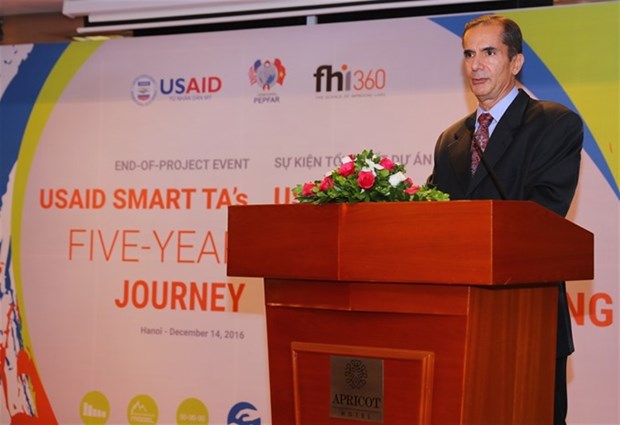
 More than 280,000 people have received free HIV tests and 15,000 patients were newly enrolled for over the last five years (Photo: daidoanket.vn)
Hanoi (VNA)
– More than 280,000 people have received free HIV tests and 15,000 patients
were newly enrolled for anti-retroviral treatment over the last five years.
A conference held on
December 14 in Hanoi to wrap up a national project on sustainable management of
HIV/AIDS response also heard that nearly 19,000 people injecting drugs have
been given methadone treatment this year.
This accounted for 20 percent of total methadone treatment patients in the
country.
The 45 million USD, five-year (2011-2016) project on Sustainable Management of
HIV/AIDS Response and Transition to Technical Assistance (SMART TA) was funded
by the US President’s Emergency Plan for Aids Relief.
In its final year alone, the project provided treatment to more than 23,000
people living with HIV, the conference heard.
The project was implemented by the US Agency for International Development
(USAID) in 11 provinces.
USAID Vietnam Mission Director Michael Greene said that Vietnam has achieved
great results in HIV response in recent years.
The response increasingly relies on local resources such as health insurance;
and national and provincial funding have become key support sources, he noted.
The project has also helped integrate HIV services into the curative health
system where facilities can be reimbursed through social health insurance, he
said.
HIV patients in the northern
province of Dien Bien and the central province of Nghe An were the first to
receive social health insurance reimbursement for HIV services.
Nguyen To Nhu, deputy chief of the project, said that one of the achievements
of the project was its work in mountainous areas, where many people cannot
access health services because of the long distance between their houses and
local health clinics.
The project provided
mobile laboratories to provide HIV tests for people in mountainous areas, and
results were provided in 24 hours instead of the usual week.
She cited Que Phong and Quy Chau districts in Nghe An as examples. After
establishing mobile and satellite laboratories in these localities, as many as
500 at-risk people in Que Phong district and more 300 in Quy Chau district have
been tested.
Phan Thi Thu Huong,
deputy director of Vietnam Authority of HIV/ Control, said that after five
years of implementing the project, the number of newly-infected people in HCM
City has reportedly not decreased.
In the 2011-2015 period, infections through sexual transmission accounted
for 57.5 percent and blood transmission was 41.3 percent.
She said it is necessary to strengthen preventive work, and ensure that at
least 90 percent of patients knew their status, 90 percent of those who knew
their status were on treatment and 90 percent of those on treatment were
virally suppressed. These targets would help country could stamp out the HIV
epidemic by 2030, she said.
As international donors have begun phasing out assistance, health insurance for
people living with HIV/AIDS has become crucial for prevention, testing and
providing anti-retroviral (ARV) treatment, health officials said.
The AIDS response overall is funded mainly by international donors who provide
70 to 80 per cent of all funds.
Some aspects of the response, particularly ARV treatment, are fully funded by
donors.
Coverage of HIV treatment by the national health insurance scheme is crucial to
increasing domestic funding of the AIDS response, as external funding will come
to an end next year, they added.
Only 40 percent of people living with HIV have health insurance, according to a
report released by the Ministry of Health.
Most people living with
HIV are poor, many of whom are without a permanent residence or a stable job
with health insurance, said Nguyen Huu Hung, deputy director of the HCM
City’s Department of Health.
As ARV treatment has been made available free of charge due to international
donor support, people living with HIV have found it unnecessary to purchase
health insurance.
HIV-related stigma and discrimination remain significant barriers to providing
health insurance coverage to infected people.
Many people living with HIV are afraid of their condition being made known
to the public and refuse to join a health insurance scheme, Hung said.
Nearly 50 percent of people living with HIV in HCM City are covered by health
insurance, but very few use the insurance cards for health exams because of
anxiety about discrimination.
The number of people living with HIV in the city is estimated at 41,000, with
nearly 28,000 people under ARV treatment, he said.
It is estimated that ARV treatment costs 12,000-24,000 VND for ARV treatment
per person per day.
The financial burden of treatment costs could hinder access to ARV treatment
for poor, uninsured people living with HIV, he added.
According to the HIV/AIDS Prevention and Control Department, ARV treatment
costs around 420 billion VND (18.58 million USD) per year.
The Prime Minister has ordered local authorities to create the most favourable
conditions for all people with HIV/AIDS to join the national health insurance
scheme.
Local health sectors have been asked to sign contracts with health insurance
agencies to ensure benefits for insured people with HIV/AIDS.
Insured people living with HIV/AIDS will enjoy full payment for ARV treatment
from health insurance agencies and the local State budget.
The number of people living with HIV is estimated at 230,000 in Vietnam. A
total of 8,059 people were diagnosed with HIV infection nationwide in the first
10 months of the year.-VNA
Source: VietnamPlus


