
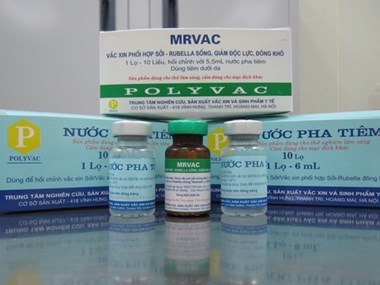
 Illustrative image (Source: VNA)
 Hanoi (VNA) –
Vietnam is expected to produce six-in-one vaccines in 2017 or 2018 and by 2020
these will be used widely in the country, according to the Ministry of Health.
Vietnam already manufactures
11 out of 12 vaccines used in the nationwide expanded free immunisation
programme for children, including vaccines against tuberculosis, diphtheria,
whooping cough, tetanus, measles, poliomyelitis, hepatitis B, Japanese
meningitis B, cholera, typhoid and rubella.
In November 2016,
Vietnam announced the successful production of a measles-rubella vaccine (MR)
for the first time.
Vietnam is one of only
25 countries in the world that can produce vaccines and is the fourth in Asia
to manufacture the MR vaccine, following Japan, India, and China, the Nhan Dan
(People) weekly reported.
This is the first vaccine
that has been produced in Vietnam by the health ministry’s Centre for Research
and Production of Vaccines and Biology (POLYVAC) under a technology-transfer
project launched by the Japan International Co-operation Agency (JICA).
In 2015, the WHO
certified that Vietnam has a fully-equipped national regulatory authority (NRA)
system that ensures the safety and efficacy of vaccines produced and used in
Vietnam.
Deputy Health Minister
Nguyen Thanh Long said the NRA achievement would open up opportunities for Vietnam
to export vaccines and contribute in the fight against global epidemics.
In a recent NRA
assessment, the said that four of Vietnam’s vaccines ─ Japanese B
encephalitis, measles, hepatitis A, and hepatitis B ─ can apply for WHO
pre-appraisal before being sold in bulk to international organisations.
Local vaccine
manufacturing facilities can currently supply enough doses for both domestic
needs and export demand.
In recent years, the
Company for Vaccine and Biological Production No.1 (VABIOTECH) has exported
over three million doses of Japanese B encephalitis to India. Japanese
encephalitis vaccines are also penetrating the market of East Timor. In
addition, 32,000 doses of hepatitis A vaccine have been exported to the
Republic of Korea and 115,000 doses of oral cholera vaccine to Sri Lanka, the
Philippines and India.
Vietnam currently has
four factories producing vaccines, using equipment and technology that meets
CGMP-WHO standards: VABIOTECH; Pasteur Da Lat Vaccine Company (DAVAC); POLYVAC;
and the Institute of Vaccines and Medical Biologicals (IVAC).
However, challenges
remain ahead for the vaccine production. Việt Nam is able to produce only
single vaccines or certain types of material for mixed vaccines (multi-function
vaccines that have from four to six vaccines in one dose).
In 2019, Việt Nam will
no longer receive support from the Global Alliance for Vaccines and Immunization
(GAVI) in regard to the five-in-one vaccine that protects people from
diphtheria, tetanus, whooping cough, polio, and Hib disease.
The health sector is
making efforts to produce five-in-one and six-in-one vaccines but is still
encountering difficulties relating to technology and capital.
Deputy Minister Long
said the research and production of five-in-one and six-in-one vaccines was
among the top priorities of the country, and urged the supply of improved
technology to produce such vaccines.-VNA
Source: VietnamPlus


