

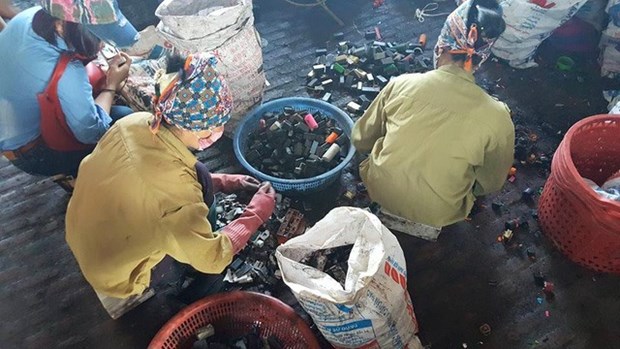
 Accumulator recycling at craft villages poses high risk of lead poisoning. (Photo: dantri.com.vn)
 Hanoi (VNA) – The National Institute of
Occupational and Environmental Health under the Health Ministry has conducted a
on Vietnamese people who are highly exposed to lead.
The purpose of the examination is to
help them reduce the risk of and poisoning.
This month the institute took blood
samples of 60 children in Phu Xa ward in northern Thai Nguyen city of Thai Nguyen
province to determine the level of lead.
Last month children with exposure to lead
in Dong Hy district in Thai Nguyen province and Cho Don district in northern Bac
Kan province also underwent testing.
It is part of a research being conducted
by the institute on lead poisoning of Vietnamese children. The research focuses
on assessing environment situation, its impact on children’s health and mapping
out measures.
The research was conducted in localities
which have mine ores, metallurgy, recycling and make lead-containing waste,
such as Hung Yen, Thai Nguyen and Bac Kan provinces.
Following testing results, the institute
will instruct locals to take intervening and preventive measures against lead
poisoning.
The institute has also worked with local
medical facilities to disseminate knowledge to raise local awareness on
culprits and the impacts of lead on health.
According to a representative of the
National Institute of Occupational and Environmental Health, sources of
lead pollution originate from mining, metallurgy, recycling and the use of lead
in paint and petrol.
Children are the most vulnerable to lead
poisoning, which may result in serious and long-term consequences, especially
the impact on the development of a child’s brain and nerve system. Lead
also poses a threat to adults, such as the risk of high blood pressure and
kidney failure.
Dr Doan Ngoc Hai, head of the National Institute
of Occupational and Environmental Health, said the release of lead can be
done but is unsustainable. Following the release, children return to live in
the lead-polluted environment and are exposed to lead again.
She advised residents not to be lured by economic
benefits and ignore their health, in addition to suggesting planning of lead
recycling villages.
The Natural Resources and Environment Ministry’s
latest nationwide survey of 52 handicraft villages has revealed that 46 percent
of them are severely polluting the area’s air, water and land, as well as
causing noise pollution.
The survey also shows that people who live in or near
such craft villages are at higher risk of suffering from respiratory problems,
cancer and mental ailments.-VNA
Source: VietnamPlus


