

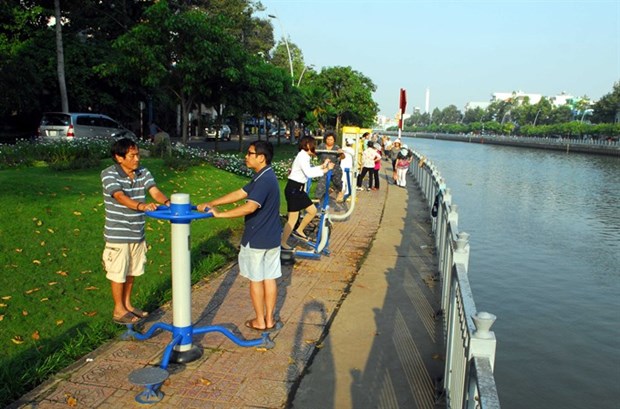
 Older Vietnamese exercise on the side of the Nhieu Loc – Thi Nghe canal in HCM City (Photo: VNA)
Hanoi (VNA) – Like many other countries in the region, Vietnam faces the question of
how to care for its , most essentially when it comes to
providing health care.
The issue was the focus of the workshop on “Health security of older persons: a
survey of five ASEAN countries,” recently held by the Institute of Public
Policy and Management (IPPM) at the National Economics University in Hanoi.
Researchers
from Singapore, Malaysia, Thailand, Myanmar and Vietnam – together with a
number of experts and representatives from agencies specialising population
ageing issues in Vietnam – participated in the discussion.
Associate
Professor Giang Thanh Long, Director of IPPM, stressed the importance of
developing health security programmes for Asian countries in general and the
five countries surveyed in particular.
Even with
considerable disparity between per-capita income among these countries, they
all experience accelerated ageing. Therefore, studies and reviews on the
effectiveness of policies will provide learning opportunities for all involved.
Delegates
discussed how an ageing population leads to a rise in non-contagious but
chronic diseases – such as cancer, diabetes, or cardiovascular diseases. These
diseases require an overhaul of health care system, from facilities to
personnel, further straining the already limited State budget.
Other
aspects of elderly health care also need to be mainstreamed into State
policy-making decisions: such as access to these healthcare services, and
elderly satisfaction with health care.
Speaking at the workshop, Dr. Theresa
Devasahayam, fellow and researcher-in-charge from Institute of Southeast Asian
Studies in Singapore, said that the country’s government wants to push family
values. Therefore, it has implemented a number of policies to encourage
offspring and youngsters to take care of the elderly people – such as tax cuts
and preferential housing prices for those living with their senior parents.
However,
a noteworthy issue, as Theresa pointed out, is that the living cost in
Singapore is exorbitant; it is one of the most expensive cities in the world.
Therefore, ensuring an income that can comfortably cover expenses, including
healthcare for low-income or irregular income earners, needs to be taken into
account.
Associate
Professor Ling How Kee from the Social Science Faculty of Malaysia’s Unimas
University, said that the country also holds family values in high regards.
It’s often the case that old parents wish to live under the same roof with their
children and grandchildren.
However,
the elderly are feeling the profound impact of increasing migration from rural
areas to urban centres.
Thailand,
despite its trend of fewer children are living with their parents, still places
a high premium on family relationships, thanks in large part to frequent
communications, Associate Professor Rossarin Gray, who is serving as Deputy
Director of the Institute for Population and Social Research at Mahidol
University, said.
Giving a
low-income country perspective, Malaysian Professor Hein Thet Ssoe, from
HelpAge International – an international NGO that offers support for the
elderly – said the country’s government is encouraging children to live with
their parents.
However,
like other Asian countries, stark and ever-expanding generational differences
have led to a mounting preference for adult children to move away from their
parents, causing a drop in number of the traditional multigenerational family.
In Myanmar, nonagenarians and older are given a monthly subsidy, in addition to
free-of-charge health check-ups and treatment, he added.
Vietnam can
learn from best practices implemented by other countries to deal with ageing
populations. For example, the measures Thailand has taken to extend health care
coverage to all people, or the shift towards a community-based geriatrics
scheme.
Policies
that provide financial support in housing purchases for adult children who want
to live with their parents, if done right, can sway the trend of nuclearisation
of households.
Considering the ageing Vietnamese population, the speakers all recommended the
Vietnamese Government not only to pay attention to health care for old people
as a standalone part in the health care system, but also consider a total
overhaul of social security and health insurance. Its end goal should be a
‘successfully ageing society’ – where older people are able to achieve
financial security, health care insurance, and active engagement in social
activities.
The
Government should reorient the delivery system from the intensive use of
hospital care to greater reliance on improved primary care and reform provider
payment mechanisms from fee-for-services to case-based approaches, recommended
Phillip O’Keefe, World Bank’s Regional Lead Economist for Human Development for
the East Asia and Pacific Region.
In
closing, he said that adopting good practices and learning from similar
countries’ social and cultural experience will always yield numerous benefits.-VNA
Source: VietnamPlus


