

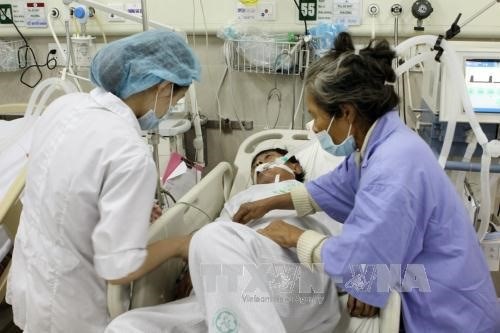
 Medical staff perform emergency treatment for a stroke patient at Bach Mai Hospital in Hanoi. (Photo: VNA)
Hanoi (VNA) – One morning last month 53-year-old Hanoi resident Vu Huu woke
up feeling weak over half of his body. He could barely grasp items with his
hands and his legs felt like jelly.
With
a medical history of having diabetes and hypertension, he immediately went to Bach
Mai Hospital.
“Doctors
said I had a light ischemic stroke due to a cerebral embolism,” Huu said. He
recovered shortly after receiving treatment.
Huu’s
timely reactions saved his life. But several were only taken to
hospitals when complications – like paralysis – have occurred, or after they
have fallen into a coma due to insufficient knowledge on stroke symptoms,
according to Prof Dr Le Van Thinh, dean of the neurology department at Bach Mai
Hospital.
Some
200,000 Vietnamese citizens suffer strokes each year, according to the Vietnam
Stroke Association. Half of them die; another 30 percent are at high risk of
paralysis.
Stroke
is the third leading cause of death in the country behind heart-related
diseases and cancer, and had the highest disability rate, according to the
association.
A
is a medical emergency that occurs when blood vessels in the brain are
blocked or ruptured, interrupting the blood supply to the brain and causing
brain cells to die within minutes. Clinical symptoms of stroke include
hemiplegia (paralysis on one side of the body), incoherent speech or patients
falling into coma.
As
the number of stroke patients increased over recent years, the Ministry of
Health (MoH) last year issued Circular No. 47 to regulate stroke examinations
and treatment at medical units nationwide, which takes effect from today.
Depending
on their capability, one of the following stroke response task forces must be
formed at each and every medical unit: stroke team, stroke unit, stroke
department or stroke centre, said Luong Ngoc Khue, Director of the ministry’s
healthcare management department. They must operate 24 hours a day and 7 days a
week to ensure timely treatment for stroke patients and reduce sequelae of
cerebral strokes, he said.
Doctors
at HCM City Medicine and Pharmacy University recently succeeded in saving a
stroke patient’s life thanks to the hospital’s stroke alert process.
At
home, the 42-year-old patient suddenly found it difficult to speak. His face
and mouth became distorted, the left half of his body paralysed.
The
hospital’s stroke alert system was initiated right after the patient was
hospitalised with the involvement of the majority of doctors at the emergency
department, the neurology department’s stroke unit, the diagnostic imaging
department and a crew of cerebrovascular intervention doctors.
An
emergency CT scan showed that the patient had had a brainstem infarction due to
an occlusion of the basilar artery. His family said it had been his habit in
the last 10 years to smoke 1.5-2 packs of cigarettes per day.
Process
improvement
The
treatment process for cases of acute cerebral infarction had been improved by
the cerebrovascular pathology department of the People’s Hospital 115 in HCM
City in order to save time for patients, said Nguyen Dinh Phu, vice director of
the hospital.
The
duration of the intravascular interventional treatment phase had been
shortened, enabling doctors to enter the decision making phase earlier, he
said.
Specifically,
contacts of vascular intervention doctors are included in their online duty
schedule so that they could be reached anytime, even at midnight.
Administrative and financial procedures are processed quickly. Advance payments
can be made by the hospital to cover patients’ medical fees.
In
addition, consultations between leaders of departments can be done via
smartphone applications. Diagnosing images can also be transferred via
smartphones.
The
shortened process would improve neurological rehabilitation after 3 months of
treatment for cerebral infarction patients, Phu said.
The
hospital would continue to improve the process by increasing collaboration
between the emergency, diagnostic imaging and clinical laboratory departments,
he added. It would focus on shortening the duration of the blood collection and
process phases in preparation for interventional treatment, he said.-VNA
Source: VietnamPlus


