

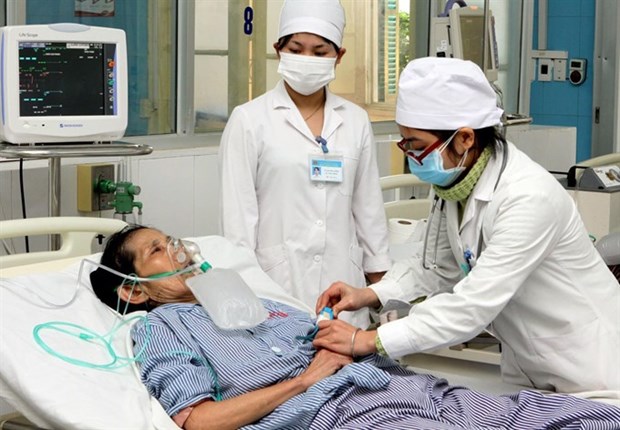
 Doctors treat a TB patient in the intensive care unit of the Central Pulmonary Tuberculosis Hospital in Hanoi (Photo: VNA)
of funding and trained personnel, as well as social discrimination, are
undermining Vietnam’s hard-won success in combating the scourge of
tuberculosis.
On the occasion of World TB Day 2017 (March 24) Nguyen Viet
Nhung, director of the Hanoi-based Central Pulmonology Hospital that oversees
over 60 hospitals around the country, provided an overview of the
country’s efforts to control the world’s No 1 killer infectious disease and set
out its ambitious goals.
Nhung, who is also head of the
country’s national TB prevention and control programme, told the Vietnam News
Agency that Vietnam ranked 15th among 30 countries with the
highest number of TB patients in the world. It also ranked 15th among
30 countries with the biggest burden of multi drug-resistant TB in the world.
According to Nhung, Vietnam’s success in prevention
has been recognised internationally over the years. Each year, the country
detects and provides treatment for 100,000 people with tuberculosis, with a
cure rate of over 90 percent for new cases.
Most of the new technologies applied in tuberculosis treatment
appear to be effective. However, the country faces a shortage of competent
healthcare providers, especially in disadvantaged remote areas, he said.
Funding was also an issue as Vietnam is estimated to need at
least 66 million USD to reduce the prevalence of
patients with TB per 100,000 people from the current average of 112 to 20 by
2030, essentially eliminating tuberculosis as a public health problem.
But the national programme on TB prevention and control is
currently funded at 26 million USD a year, including 19 million USD from
foreign aid, Nhung said.
Vietnam has also experienced an alarming rate of multi drug-resistant
tuberculosis (TB), he said.
About 130,000 people are diagnosed in Vietnam with TB yearly, of
whom about 7,000 have both TB and HIV, over 5,000 have multi drug-resistant TB,
and about 300 patients have extensively drug-resistant TB.
Nhung said that the high rate of multi drug-resistant TB was the
result of patients’ failure to strictly follow doctors’ treatment regimes.
“Skipping drugs or treatment also causes difficulties in TB prevention and
control for the community,” Nhung said.
Nhung said that TB patients were vulnerable to other infectious
diseases like HIV. Most TB patients are poor, with little access to proper
understanding about the disease and measures to curb its spread.
Social discrimination has made TB patients hide their disease,
compounding the problem, Nhung said.
At a conference early this year in HCM City, Nguyen Thi Thanh Nhan,
head of the southern region’s national TB prevention and control office, said
that an increase in the number of resistant TB cases has occurred in the
southwestern region of the country.
Nearly 1,300 patients with such resistant TB were diagnosed every
year in the southwestern region, accounting for 25 percent of the total number
in the country. Between 2011 and 2015, the prevalence of patients with TB per
100,000 people in the region was 141.
At a meeting to mark the World TB Day held in HCM City on March 28,
the head of the city’s Public Health Association, Le Truong Giang, said that a
programme titled “Right Care” should be expanded across the city to better
detect new TB patients or those with multi drug-resistant TB through new
testing techniques. The programme also focuses on detecting TB among children.
At a similar meeting held last week in northern Son La province,
vice director of the province’s health department, Tran Van Ngoc, said that in
the mountainous disadvantaged province, a majority of TB patients were the
bread-winners of poor families. “They found it hard to follow
six-or-12-month-long treatment despite receiving free medicines,” Ngoc said.
More public communication and participation are needed to improve
TB prevention and control, he said, adding that removing social discrimination over
the disease would help detection and cure.
According to the World Health Organisation, TB claims 5,000 lives
each day. The theme of World TB Day 2017 is “Unite to End TB.”
“TB strikes some of the world’s poorest people hardest,” said Dr
Margaret Chan, WHO Director-General. “WHO is determined to overcome the stigma,
discrimination, and other barriers that prevent so many of these people from
obtaining the services they so badly need.” -VNA
Source: VietnamPlus


