

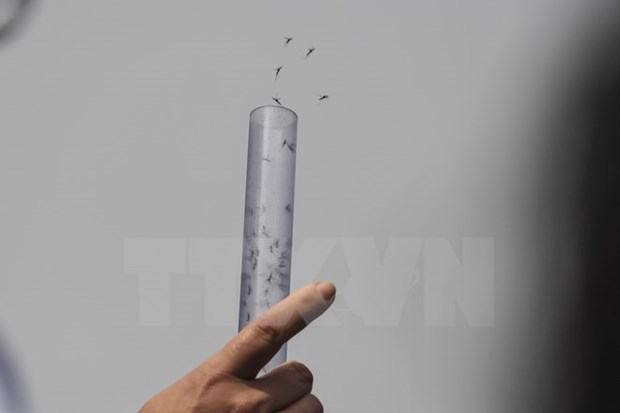
 Wolbachia-infected mosquitoes are released into the wild in Rio de Janeiro (Photo: AFP/VNA)
Hanoi (VNA) – The (MoH) is
planning to expand the pilot release of in some
southern areas of Vietnam in the next few years to prevent .
The MoH’s Preventive Medicine Department said on
September 7 that representatives of the ministry and some institutes recently
had a working session with Prof. Scott O’Neil from Australia’s Monash
University, who leads the global , to discuss the
plan.
The department said dengue fever is currently a
major public health issue. It has become an epidemic nationwide with tens of
thousands of infected cases every year. Notably, in 2017, dengue fever has
broken out in many localities and lasted for many months with total cases much
higher than the previous years, especially in Hanoi.
The disease is transmitted via Aedes aegypti
mosquitoes which are present in almost all localities in the country. Dengue prevention
has encountered an array of difficulties since there haven’t been any vaccines
or specific medicine. The key prevention measure is to control mosquitoes.
A promising measure that has been piloted in Tri
Nguyen Island, the south central province of Khanh Hoa is to infect Aedes
aegypti mosquitoes with Wolbachia bacteria and then release them into the
environment.
Wolbachia is a
natural bacterium present in about 60 percent of insect species,
including some mosquitoes. However, it is not usually found in the Aedes
aegypti mosquito.
Global scientists succeeded in infecting Aedes
aegypti mosquitoes with Wolbachia and proved that this bacterium can curb the
growth of dengue, Zika and other viruses inside the mosquito and their
transmission to human.
While female mosquitoes with Wolbachia pass this
bacterium to following generations, those without Wolbachia are unable to
reproduce when they mate with male mosquitoes with the bacterium. Therefore,
the long-term effect of the use of Wolbachia will be maintained while the
number of mosquitoes will not increase.
The Preventive Medicine Department said the
research team of the National Institute of Hygiene and Epidemiology and
Australian scientists successfully raised Aedes aegypti mosquitoes with
Wolbachia. These mosquitoes were introduced in Tri Nguyen Island in two phases,
from April to September 2013 and from May to November 2014.
Surveys in recently years showed that while the
number of dengue fever cases in Khanh Hoa was very high, there hasn’t been any
concentrated dengue fever hotbeds in Tri Nguyen Island since the last release
in 2014. In August 2016, the MoH recognised the safety and effect of
Wolbachia-infected mosquitoes and the use of these mosquitoes received support
from the local community, the department noted.
The Eliminate Dengue programme in Vietnam is
asking for permission to pilot the release of Wolbachia-infected mosquitoes in
a small mainland area in Nha Trang city from late 2017.-VNA
Source: VietnamPlus


