

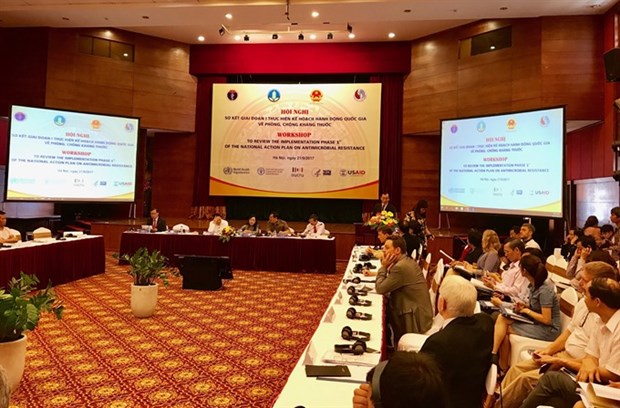
 Dr Kidong Park,WHO representative in Vietnam, calls for more efforts to be stepped up in combating antimicrobial resistance (AMR) at a workshop on September 21 in Hanoi. (Source: VNA)
Hanoi (VNA) – The health sector called for efforts to be stepped
up to combat antimicrobial resistance (AMR) at a workshop on September 21 to
review the first-phase implementation of the National Action Plan on
Antimicrobial Resistance in .
Speaking at the event, Minister of Health Nguyen Thi Kim Tien said AMR has been
an alarming problem in Vietnam, especially the issue of antibiotic
resistance in the food chain and ecological environment due to
the increase of antibiotic use and weakness in antibiotic management in
healthcare and animal husbandry.
She said survey results on selling antibiotics at retail drug stores in the
north showed weakness in the community’s awareness of antibiotics and AMR.
“Antibiotics have been sold without prescriptions at 88 percent of urban
drugstores and 91 percent of rural drugstores. Antibiotics have contributed to
13.4 percent of drugstores’ total sales in urban areas and 18.7 percent of
drugstores’ total sales in rural areas,” said Tien.
Tien stressed that reducing antibiotics use and combating AMR requires the
involvement of all ministries and sectors from the central to the local levels
and all of society.
Speaking at the event, Dr Kidong Park, the World Health Organisation (WHO)
representative in Vietnam, praised the contributions of Vietnam in the global
fight against AMR.
“The current burden of AMR is just the tip of the iceberg for the future burden
of AMR. If we don’t want to see the full-blown burden of AMR, we must take
action now,” said Park.
At the event, participants focused their discussion on the results and existing
shortcomings of efforts to advance the fight against AMR in Vietnam.
Representatives of the Ministry of Agriculture and Rural Development and the
Veterinary Department suggested the State management authorities should
strengthen supervision and early warnings of diseases affecting animals and
poultry.
Management authorities should expand communication campaigns to strengthen the
community’s awareness of antibiotics and AMR prevention, tighten inspections
and strictly handle violations related to illegal trading and use of prohibited
antibiotics and veterinary medicine in breeding and aquaculture.
According to WHO, the estimated death toll due to AMR reaches some 700,000
per year globally. Failure to control AMR will lead to an increase in
cases of up to 10 million per year by 2050, which is more than
the estimate for cancer and ten times more than that for diabetes. Further, the
economic cost of AMR in 2050 will go up to 100 trillion USD.
In 2013, Vietnam passed the National Action Plan on AMR as the first country in
WHO’s Western Pacific Region to do so. Last month, the Ministry of
Agriculture and Rural Development, with support from the United Nations
Food and Agriculture Organisation, adopted a National Action Plan to tackle the
overconsumption of antimicrobials in livestock and fisheries.-VNA
Source: VietnamPlus


