

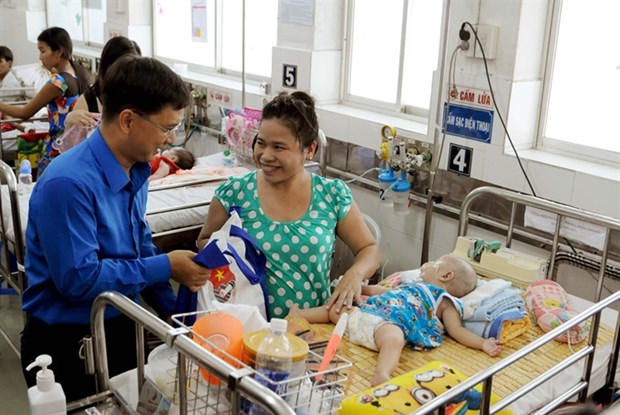
 A mother takes care of her baby at Children’s Hospital 1 in HCM City. All public hospitals in HCM City plan to implement financial and managerial autonomy from October 1 (Photo: VNA)
Public hospitals in will have to implement financial and
managerial autonomy from October 1, but are facing many challenges in order to
ensure successful operations according to the new model.
Financial autonomy is designed to
help reduce so that funds can be diverted to preventive
medicine and targeted to community-care programmes. Reduced State spending will
also allow the State to pay for more health insurance cards for the poor,
including those near the poverty line and welfare recipients.
Although hospitals are expected
to become a high-quality service industry and will no longer be overloaded if
they have more funding, some hospitals worry about financial shortages if the
model is widely applied.
The newly built Cu Chi Hospital
in Cu Chi district on HCM City’s outskirts has a capacity of 300 beds but
attracts far fewer patients due to a lack of high-skilled doctors that
reduces confidence in the quality of care, according to hospital director Ho Hai
Truong Giang. The hospital chiefly provides healthcare services for social
welfare beneficiaries and families rendering great services to the revolution.
Giang said due to the lack of
patients, the hospital’s total revenues are low. If autonomy is applied, the
hospital’s State budget will be cut, preventing it from training staff and
developing services and specialties to attract more patients, Giang
warned. He also suggested that autonomy should be applied gradually to
ensure a smooth transition from State funding to a market mechanism.
Other small district-level
hospitals, such as hospitals in Can Gio and Nha Be districts, face the same
problem.
Deputy Director of the HCM City
Department of Health Tang Chi Thuong admitted that hospitals will initially
face difficulties because they rely solely on the State budget.
Director of District 2 Hospital
Tran Van Khanh said some hospitals of lower quality and prestige that do not
attract enough patients will face many difficulties when they implement full
, making it harder for them to improve. He advised
hospitals to balance their spending and collection and carefully calculate
costs to ensure efficiency and avoid unnecessary spending.
The District 2 Hospital is among
10 public hospitals chosen to pilot the autonomy mechanism from 2016. The
hospital invested in improving infrastructure and purchasing equipment as well
as in developing more specialty departments and using complex techniques
to attract patients, according to Khanh. Additionally, to satisfy
patients, the hospital has also focused on administrative reform and improving
medical workers’ attitudes towards patients, he said.
Sharing the same view, deputy
director of the municipal health department Thuong said medical staff need to
consider patients as customers to provide the best service in order to bring in
money. “If hospitals do not treat patients well, they will not come back,”
he said.
The health department will
strictly supervise after implementing autonomy, he said.
Eighty two hospitals have been
granted autonomy since the city began implementing this policy in 2006, he
said. Ten managed to mobilise all the revenues they need to operate while the
remaining are able to fund themselves in part.-VNA
Source: VietnamPlus


