

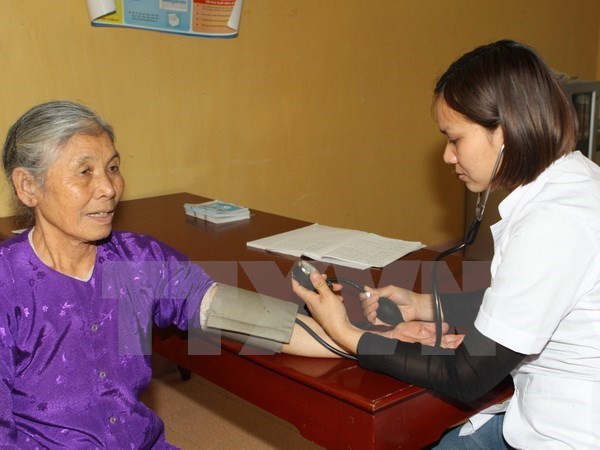
 A doctor gives check-up to an elderly woman (Photo: VNA)
Hai Phong (VNA) – A has
opened in Hai Phong city for 19 who have volunteered to work
in various remote localities in the country.
The programme will train the young volunteers for two years in seven
specialties: internal medicine, surgery, obstetrics, pediatrics, anesthesia,
diagnostic medical imaging and infectious diseases at the Hai Phong University
of Medicine and Pharmacy.
The graduates were chosen by the Ministry of Health (MoH) based on outstanding
academic performances.
The training programme is part of a pilot project, started by the ministry in
2013, that sends medical graduates to disadvantaged areas, including
mountainous regions, border areas and islands.
It was prompted by a shortage of about 600 medical specialists in 62 poor
districts of the country, according to Dr Pham Van Tac, project director as
well as director of the ministry’s Department of Organisation and Personnel.
“Some hospitals in the mountainous districts of the Lai Chau, Son La, Cao Bang
and Ha Giang provinces only have four to five doctors; and some don’t have
any,” he told the Hanoi Moi (New Hanoi) newspaper.
“Meanwhile there are about 140 doctors in just a single district in Nam Dinh province.
It’s a huge discrepancy,” he said.
After getting project approval in February 2013, over the last three years, the
ministry has collaborated with the Hanoi Medical University to organise five
training programmes for 78 medical graduates who volunteered to work in 37 poor
districts across 13 provinces.
The 78 chosen were medical students who’d graduated with distinction and
volunteered to join the project, said Associate Professor Nguyen Duc Hinh,
principal of Hanoi Medical University.
These students will work at central hospitals for a short period of time before
joining a two-year specialist training programme, after which they will be
considered “doctors”, and sent to work at district-level hospitals in poor
provinces for four years (men) and two years (women), he added.
“After that they get to choose whether to go back to the central hospitals
where they previously worked, or transfer to local hospitals in their
hometowns,” he said.
In July, the first seven medical volunteers who completed their training were
sent to Lao Cai province’s Bac Ha and Muong Khuong districts, Son La province’s
Sop Cop district, Bac Kan province’s Pac Nam and Ba Be districts, and Dien Bien
province’s Muong Nhe district.
Soon after he was sent to the Bac Ha General Hospital, surgeon Nguyen Chien Quyet,
28, performed an endoscopic surgery on a Mong man suffering from
appendicitis.
“I hadn’t had much experience at that time and hadn’t even got used to working
with my colleagues. But luckily the operation turned out fine,” Quyet said.
“From then on, I was determined to apply to the fullest what I had learned in
school to take care of the local people here,” he added.
The have anticipated the struggles and difficulties that come
with working in remote areas among ethnic minority people whose languages they were
not familiar with, said Tran Thi Loan, a female doctor from that first batch of
seven, who was sent to the Muong Khuong General Hospital in Lao Cai province.
“I got used to them after a while,” she said. “Now I’m confident that I’ll
‘nail’ my two years of duty here.”
Despite the well-meant intention to alleviate doctor shortages, directors of
many local health departments have raised concern over the project’s
effectiveness in the long run, said project director Dr Pham Van Tac.
“Some say that two to three years are too short for the medical volunteers to
actually improve their skills and help increase healthcare quality at
district-level hospitals. Not to mention the ‘gaps’ left by these doctors when
they fulfill their duty and leave,” he said.
The MoH will reconsider the duration of deputation, starting with the next
batch of medical volunteers, Tac said. It will also work to retain them in the
poor districts, he added.
The ministry will also consider providing specialist training for local doctors
in the poor areas so that they can fill up the spots left by the volunteers, he
said.
The project expects to send 300-500 doctors to 62 disadvantaged districts by
2020.-VNA
Source: VietnamPlus


