

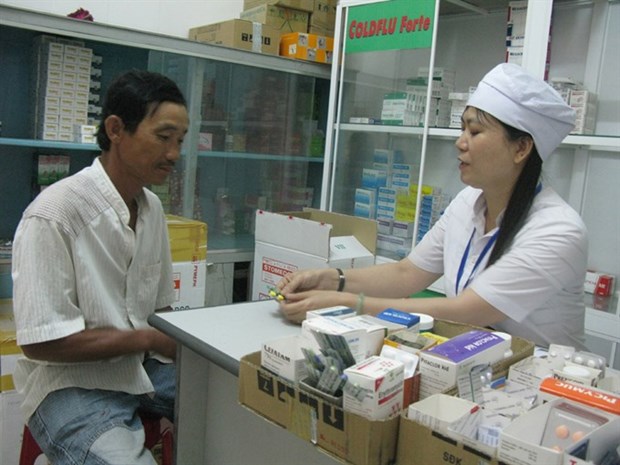
 A health worker at Tuy Haa City Healthcare Centre in the central province of Phu Yen gives medicine to a man suffering from tuberculosis. (Photo: VNA)
Hanoi (VNA) – About
126,000 people have tuberculosis (TB) in Vietnam, but fewer than 106,000 have
received treatment, while the others are undetected and sometimes unaware of
their status, said Director of the Hanoi-based Central Pulmonology Hospital Nguyen
Viet Nhung.
He said that the gap in
poses a high risk to the lives of people with TB as well as
to public health.
“Forty percent of the
undetected TB patients will die because they haven’t treatment,” Nhung said.
Nhung, who is
also head of the country’s national TB prevention and control programme,
said that people with TB do not always announce their conditions because they
are unaware of the disease or afraid of discrimination, so they do not seek medical
treatment.
Nhung said that with
current techniques and tests, TB could be found in two hours after testing
instead of two months as previously. It takes four months to treat TB instead
of six months as before.
It is reported that in Vietnam,
the number of people with TB has declined 5 percent yearly since 2015 and the
number of people die of TB also reduced about 3,000 people yearly.
Vietnam has made
achievements in preventing and controlling .
Under the national TB
prevention and control programme, new tests recommended by World Health
Organisation such as the Gene Xpert (a machine that can detect mycobacterium tuberculosis in a sample of sputum) or the Hain Test
are used to detect TB early and stop it from spreading.
The programme also facilitated
the use of new medicine Bedquiline and a short-term treatment scheme for
multi-drug-resistant tuberculosis.
In 2009, Vietnam started an
initiative to expand multi-drug-resistant treatment. Up to today,
about 11,000 people have received treatment; 70 percent recover.
Moreover, the health
history records of people with multidrug–resistant TB have been digitalised.
“Vietnam still faces
challenges in controlling TB. It is necessary to improve grassroots healthcare
to detect and treat TB patients early,” Nhung said.
Another challenge is that
when international donors stop funding the country’s TB control and prevention
activities, will need to find alternative sustainable funds.
As reported early this year on World TB Day 2017 (March 24), Vietnam
is estimated to need at least 66 million USD annually to
reduce the prevalence of patients with TB from 112 to 20 per 100,000
people by 2030, essentially eliminating tuberculosis as a public health
problem.
The national programme on
TB prevention and control is currently funded at 26 million USD a year,
including 19 million USD from foreign aid.
Now, the Health Insurance
Fund covers costs for TB diagnosis and treatment. Beginning in 2019, the health
insurance fund will also cover medicines for TB patients.
Nhung said that the Central
Pulmonology Hospital was planning to develop a fund to support TB treatment
next year. The fund is expected to help uninsured people buy health insurance.
Health insurance card
holders who cannot afford the co-payment for some medicines will be assisted
too.-VNA
Source: VietnamPlus


